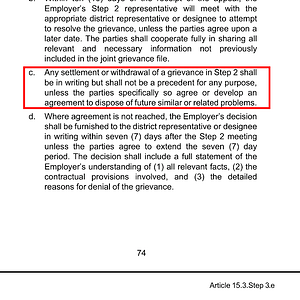
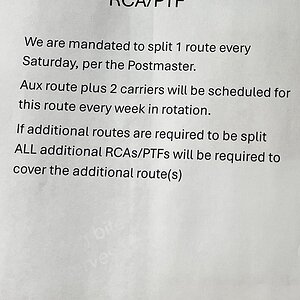
i am from the mid 80's, so forgive me if wrong, but i don't think this matches the p.o. 603
Yeah, I started in '94 and got out in '24. I looked at The 603 and there are a few sections regarding the seat belt.
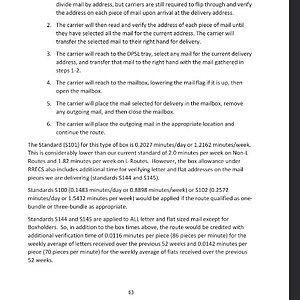
b. Seat Belt Requirements — Driving Own or Postal Vehicle
(1) Seat belts must be worn at all times when operating a Postal
Service—owned or -leased vehicle. If a privately owned
right-hand drive (RHD) vehicle is used on the route, seat belts
must be worn at all times and the carrier must be positioned
directly behind the steering wheel whenever the vehicle is being
operated. Carriers driving RHD vehicles equipped with both
shoulder and lap belts
may disengage the shoulder belt only in
those situations when the shoulder belt prevents their ability to
deliver or collect mail from curbside mailboxes. The lap belt must
be worn at all times the vehicle is being operated. A privately
owned vehicle fully equipped with dual controls (steering wheel,
brake, and gas pedals) is considered an RHD vehicle for the
purpose of this requirement.
So, what I previously posted lines up with the above. Then, there is this ;
(2) When operating a privately owned left-hand drive (LHD) vehicle,
seat belts must be worn and the carrier must be positioned
directly behind the steering wheel when traveling to and from the
route, between Postal Service units, and during any deviations
from the established line of travel beyond one-half mile for
delivery, including travel between routes when service is
provided on more than one route. A privately owned vehicle
partially equipped with dual controls is considered an LHD
vehicle for the purpose of this requirement.
After that......................we have this ;
(3) If a privately owned left-hand drive (LHD) vehicle is used on the
route, it is
advisable that the rural carrier use seat belts and be
positioned behind the steering wheel when delivery and
collection activities do not unduly encumber, delay, or fatigue the
rural carrier.
When using a privately owned LHD vehicle on the
route, the rural carrier may operate the vehicle without use of the
seat belt and/or without being positioned directly behind the
steering wheel provided the carrier determines it is safe to do so.
The rural carrier should consider the following factors when
assessing the use of the seat belt and appropriate seating
position:
(a) Distance between stops.
(b) Traffic density and weather conditions.
(c) Road design characteristics, such as number of
intersections traversed, road shoulder width, and surface
conditions.
(d) Other factors affecting safety
I am seeing that "safety" is a conflicting issue with respect to LH drive POV and RH drive POV / Govt. vehicle.
THANX
@NorthernPines !!! It sorta checks out , anyway. Depending upon the type of and who owns the vehicle.