• Everyone, please help make our jobs easier and choose the correct category. Thank you

Part 2: Distilling rule interpretations through the grievance process.

Dominator

Well-known member
Since my first attempt for clarity was withdrawn by the union at Step 1 under guidance from higher-level union reps, perhaps my issue statement just needs tweaked.⚙️⚙️⚙️

I'll feed this through the machine and see what comes out.

Given that vagueness, ambiguity, or otherwise linguistically confusing language in a postal rule creates uncertainty that risks arbitrary enforcement and loss of contractual rights, may such uncertainty be treated as a grievable harm entitling the grievant to seek a binding interpretive ruling to remedy that uncertainty?

I disagree with the union's notion that "harm" is a necessary prerequisite for a valid grievance. After all, if one cannot clearly articulate an obligation by which they are under employ, how can one effectively negotiate a monetary value (or some other benefit) in exchange for that promise? 🤔🤦‍♂️🥴

I could be wrong though. If management must first "violate unclear language" before the union will pursue it, I'd love to see how that theory ties to the definition of "grievance" (Article 15.2).

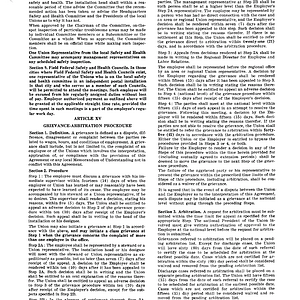
A grievance is defined as a dispute, difference, disagreement or complaint between the parties related to wages, hours, and conditions of employment. A grievance shall include, but is not limited to, the complaint of an employee or of the Union which involves the interpretation, application of, or compliance with the provisions of this Agreement.
 
perhaps my issue statement just needs tweaked
You and I know that it isn't your issue statement that needs tweaked.
I disagree with the union's notion that "harm" is a necessary prerequisite for a valid grievance.
Is that their "reasoning" for withdrawing the grievance ? If so, THAT is in direct conflict with the language in The Nat'l Agreement.

If management must first "violate unclear language" before the union will pursue it
Using their "logic", how would a potential grievant even suspect a violation occurred if the language is unclear to said potential grievant in the first place ? Of course, this "mindset" is consistent with the union's stance of being reactive instead of proactive and , thus, one never really "wins" a grievance as the damage has already been done. This same "mindset" will most certainly be carried over to Section 3 of Article 15 which states , in part ;

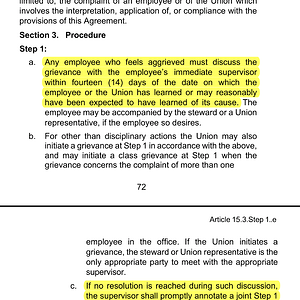
Section 3. Procedure
Step 1:
a. Any employee who feels aggrieved must discuss the
grievance with the employee’s immediate supervisor.........

So, it really doesn't matter what I think, feel, believe, etc. or what management thinks, feels, believes, etc. or even what the union thinks, feels or believes. It only , in this instance for example, matters that YOU FEEL aggrieved because of the uncertainty, vagueness, or ambiguity of some contractual language.

Even though I was disappointed, discouraged and frustrated to see that "they" withdrew your grievance, I expected no less. I always considered the fact that the union DIDN'T withdraw a grievance I filed to be HALF a victory. I know you'll figure a way over, around, or through "them" . Keep up the good fight !!!!
 
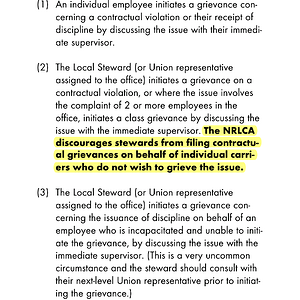
@neciat , I think the "harm" prerequisite is a spoke in the union's echo chamber theology, similar to the erroneous "stewards are limited to filing 'class action' grievances" belief.

You too see the "existence precedes essence" problem between violation suspicion/awareness and interpretation. 👏😁
  • If a violation is a prerequisite, then no "grey area" exists, making the RCAM a meaningless, financially erosive, vanity project.
  • If a violation is not a prerequisite, then interpretations must be harvested when clarity is requested.
If the union's clinging on to an "essence precedes existence" ideology, then both the union and employer could hurl spaghetti (disuptes) at a wall (through the grievance procedure) all day, then reverse engineer the origin story of those pieces that stuck, consistently identifying the opposition as the culprit. :rolleyes:

However, if the merit of my cases are just being tossed to the dumptser, and these are just the beginnings of a pattern of withdrawn grievances, that's a different road all together.

Regardless, I'm trying to be radically charitable towards the union. I don't have a lot of hope, but we'll see how it pans out. 🤷‍♂️
 
However, if the merit of my cases are just being tossed to the dumptser, and these are just the beginnings of a pattern of withdrawn grievances, that's a different road all together.
Now THAT is a road upon which you may find yourself. I went through it myself. It got to where even the shop steward was the one that actually said, " It seems that every grievance YOU file gets withdrawn." The union did not like me at all especially after I discontinued my membership. Heck, they barely even tolerated me when I was a member. I was the one that was always writing letters to them , questioning them, etc. even when the issue(s) did not pertain to me specifically. I spent more time "scuffling" with them than I did with management. I am not at your level but I can hold my own and I am formidable. Anyway, they did not like me but I know they have a personal disdain for you. And THAT alone let's me know that you are doing "the right thing". I know it has already been decided at the legal level, but I just wish the bar for DFR wasn't so low. I , personally, would rather fight and "lose" than just tap out ( withdraw ) a grievance.
 
You can file the same grievance again. We have a new person in charge of grievances for that reason. The last lady was in withdraw mode a lot.
If you dont want to re-file, you can file a National Labor charge against the NRLCA for not properly representing you.
 
@neciat , I suspect it's retaliation for challenging their constitutional integrity, but I'm intentionally choosing charity. I don't know upon which rung of the ladder of understanding the NRLCA currently stands. I also realize it could all be feigned.

@Rt2mailman , ever since the NRLCA kicked me out and severed my dues witholding agreement, I stopped keeping up with who wears what hat. I recall the National Boad was constantly loaded with members of the same area conference. I don't know if that's still the play.

Without seeing the details of grievances withdrawn by the last lady, I can't confidently claim whether I wouldn't have done the same.

Hopefully, this doesn't need to go the way of a labor charge or suit, but since the union tells me I can't file an internal appeal, a charge or suit may end up being my recourse. 🤷‍♂️

In the meantime, I'm intentionally choosing charity. 😇
 
but since the union tells me I can't file an internal appeal,
Are they citing their constitution as their reason for not being able to file an appeal ?

A . A member aggrieved by any action of the National
Association or Officer, representative or steward
thereof shall have the right to appeal directly to the
National Board.

Since you are not a member, the above would exclude you from that portion of the process. Which, to me, does not make sense because a non member can file a grievance and , yet, cannot file an appeal which is actually part of the process.
I suspect it's retaliation for challenging their constitutional integrity,
I sure hope this is not the case. Whatever happened to " without passion or prejudice " ?
 
Are they citing their constitution as their reason for not being able to file an appeal ?

In a nutshell, when the NRLCA failed to provide a copy of the kick-the-questioner-out-of-the-union appeals committee report correspondence to me via certified mail and postmarked at least 24 hours before the report was presented to the National Delegates, they violated their own administrative and due process rules.

The duped delegates bought it and adopted the committee report. The National Board followed by severing my dues witholding agreement.

I filed an internal appeal against the improper action and collateral damage. They responded that since I'm no longer a "member in good standing" (mind you, this is a result of their failed due process administration), I have no access to the internal appeals process.

I reminded them that the language states "member" and does not include a "good standing" prerequisite, as other constitutional rights that specifically require a "good standing" prerequisite. It fell on deaf ears.

For example, the NRLCA's Article 6.2.A.2 specifically limits delegates to only those in "good standing".

Only Bargaining Unit Members and Retired Members in good standing may be nominated, elected or seated as delegates. Such “good standing” status shall be the sole prerequisite for determining eligibility or entitlement to service as a delegate or to any payment or benefit, except that a state may establish reasonable rules to ensure attendance at the Convention.

In making such requirement, it indicates a necessary outcome based on the presence or absence of an element, namely "good standing". The article specifically identifies it as a "status" of a member, but does not divorce the presence or absence of that status from, the qualification of being a "member".

You quoted their article 10.2.A

A . A member aggrieved by any action of the National
Association or Officer, representative or steward
thereof shall have the right to appeal directly to the
National Board.

There is no explicit "good standing" requirement for initiating an appeal. The National Board is unwilling or unable to own that. 🤷‍♂️

Whatever happened to " without passion or prejudice " ?

Perhaps it was lost in translation. 🤔
 
Last edited:
And the results of this grievance issue... 🥁 🥁 🥁
Given that vagueness, ambiguity, or otherwise linguistically confusing language in a postal rule creates uncertainty that risks arbitrary enforcement and loss of contractual rights, may such uncertainty be treated as a grievable harm entitling the grievant to seek a binding interpretive ruling to remedy that uncertainty?

The union withdrew it at step one! 🤷‍♂️ 🤔
 
You write as if you believe the union representatives are a well-trained group. Yet you show by your personal experiences they are not.


A skilled union steward becomes that way the same way you do. They work hard to become skilled with what is available to them. Sometimes they get it right sometimes they get it wrong, but they keep working at it.


Unfortunately, this means a lot of the information about the grievance process comes from management. They don’t necessarily know the real answer. They know what they want to believe. Our people don’t know how to question what they are told. If a manager tells them a specific rule exists they don’t say show me that in writing because they are afraid of looking foolish.


I am not clear about what you are trying to accomplish. I get that you wish to deal with some gray areas in the rules and regulations. I don’t understand which rules you wish to distill as you say or specifically why.
 
You write as if you believe the union representatives are a well-trained group. Yet you show by your personal experiences they are not.
To my standards, as a whole, I don't believe the union representatives are a well trained group. While the NRLCA has the greatest access to the greatest volume of answers and evidentiary supports for its cause, the NRLCA intentionaly hordes information from its bargaining unit and flip-flops between boasting supremacy and humility.

The'll run with a superiority routine when they need to cancel other opinions and ideas to appear as an authoritative white knight.

They'll run with a humility routine when they need that "underdog" support - the "we're just a bunch of simple and humble rural carriers" show.

The levels of training within the union ranks varies, just as the levels of experience. While the NRLCA and I don't share the same standards of excellence, in my experience, the union consistently declares itself as a highly-trained group at its meetings, even to harshly criticize and ridicule others that collect with other members to exchange thoughts and ideas related to the craft, i.e., @Ruralinfo and ruralinfo.net.

A skilled union steward becomes that way the same way you do. They work hard to become skilled with what is available to them. Sometimes they get it right sometimes they get it wrong, but they keep working at it.

Perhaps the union only plays the interpretive shell game with certain members and stewards, unless this sort of stumbling block is cultural.

Unfortunately, this means a lot of the information about the grievance process comes from management. They don’t necessarily know the real answer. They know what they want to believe. Our people don’t know how to question what they are told. If a manager tells them a specific rule exists they don’t say show me that in writing because they are afraid of looking foolish.

I don't mind asking if I don't know something and want to learn. I can’t help if pride slows others from doing the same. I fearlessly raise the dispute and get silenced, whereas they cower and stay silent right out of the gate.

I am not clear about what you are trying to accomplish. I get that you wish to deal with some gray areas in the rules and regulations. I don’t understand which rules you wish to distill as you say or specifically why.

I'm trying to establish whether a grievant is entitled to an interpretation of a rule by filing an interpretive grievance.

That entitlement is a prerequisite before any specific rule is questioned.
  1. If a grievant is entitled to an interpretation of a rule through initiating an interpretive grievance.
  2. And a grievant initiates an interpretive grievance
  3. Then the grievant is entled to an interpretation of a rule.
If no such entitlement exists, I fail to see the value of a grievant's right to initiate interpretive grievances. If that's the case though, fine. I've seen in various industries what happens when management demands its employees just to "do - not think". Management gets overwhelmed once the employee responds with the mindlessness demanded.

This in mind, rather than interpreting rules and coming to my own conclusions, just to have them stricken or ridiculed, I'm leaving the onus of interpretation on the union as they desire. Why? Because I grow weary of these "that's a gray area" -type answers, or answers that are (or at least seem) contradictory or contrary to other answers.

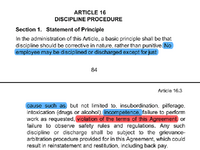
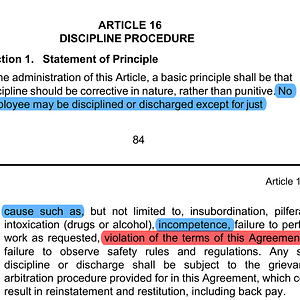
Also, the union can't seem to shake this concept of a "harm" requirement for a valid grievance, despite no obvious contractual support. I didn't get an answer to whether uncertainty could be treated as a grievable harm, yet incompetence and violation of the terms of this Agreement are things specifically expressed for discipline or discharge under Article 16.
Article 16.1.png


I can get fired for the same something that I cannot retrieve an interpretation? That just doesn't add up to me. 🤷‍♂️
 
Back
Top