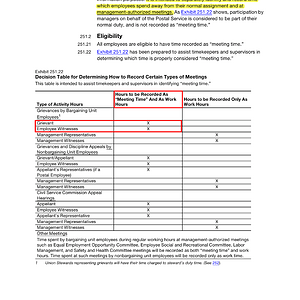
@gotstamps , while I appreciate your response, all of your responses to my 6 grievances the union withdrew
appear to me as carrying a base prerequisite that a grievance
requires a violation of a rule.
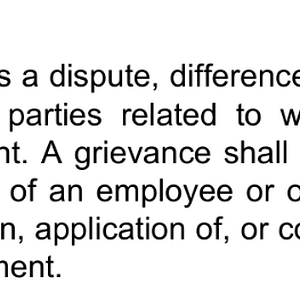
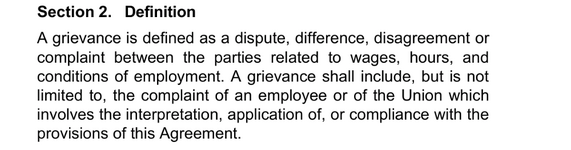
The definition of grievance doesn't state a violation is a prerequisite for interpretive grievances, and I've seen no evidence of the contrary, particularly with interpretive grievances. If you've got evidence, I'm interested in reading it.
Consider declaratory judgements; their major purpose is to
define the rights before an injury occurs. Without an interpretation, there's no "line" that can be crossed, because no "line" can be articulated. A declared position in a settlement aids to identify the rights and obligations needing interpretation.
In cases where the employer repeats a violation of the CBA, is it within the scope of the Agreement to resolve the grievance by settlement or award that includes a progressive monetary remedy for the instant case in addition to future or similarly related problems, and, if so, are there any limitations to the progression multiplier or monetary amount?
This is a question you are asking the Union. This is not a grievance against mgmt for violating the Nat’l Agreement or any Manuals.
No, this is a question I asked
management.
At the Step 1 discussion, employees can craft a settlement. This question seeks the scope of non-violative remedies, specifically the type of remedy identified within the grievance issue.
Management and I had an
interpretive difference on these
conditions of employment.
When an employee identifies a Postal rule as linguistically confusing, vague, ambiguous, or otherwise unclear, what must that employee do to aquire an interpretation of that rule which the Employer and Union agree upon as correct and proper?
-
Again, this is a question for mgmt or union and not a grievance against mgmt for a violation.
I never asserted there was a violation, and the definition of grievance doesn't require a violation as a prerequisite.
On the concept of it
being a question for management or union, consider if the union and management give me different (or even polar) answers to that question.
- Which do I go with?
- Which is controlling?
- What if mine is different from either of theirs?
That alone is evidence of an interpretive difference. Additionally, the definition of grievance includes
my interpretations as a position which may be different than the Employer. I do not need to rely on the union's interpretations before I can initiate an interpretive grievance, if they ever decide to give me one.
I realize that the union might toss
my interpretation to the curb and run with its own after the grievance is filed. At least then though, it would be pitting it's position against management's, hopefully resulting in an answer.
Given that vagueness, ambiguity, or otherwise linguistically confusing language in a postal rule creates uncertainty and risks arbitrary enforcement and loss of contractual rights, may such uncertainty be treated as a grievable harm entitling the grievant to seek a binding interpretive ruling to remedy that uncertainty?
-
This is too broad. If there are instructions given or enforced that are confusing, discuss that instruction with mgmt & grieve the instructions if no remedy can be agreed upon.
I disagree that it's
too broad. Additionally, there is no identifiable scope of broadness within the definition of grievance. On the contrary, the "not limited to" clause within the definition of grievance permits
additional broadness where it otherwise wouldn't exist without that additional clause.
The union claimed that "harm" is a necessary condition for a grievance. That in mind, I sought whether "uncertainty" (unreliable reliance) counts as "harm". If so, then the union's alleged "harm" prerequisite is satisfied.
Being these are interpretive issues, an
enforced instruction would go beyond just an interpretive issue, it tacks on application of
an interpretation (regardless of correctness).
Responding to
direct instruction is often a different frame than dissecting a
Postal rule because of
ELM 665.15's "obedience to orders" requirement. A direct order presumes a rule, its interpretation, its application, and its compliance, all while under the risk of discipline for failing to follow.
While your suggestion is valued, it pursues a different mechanism than the grievances filed.
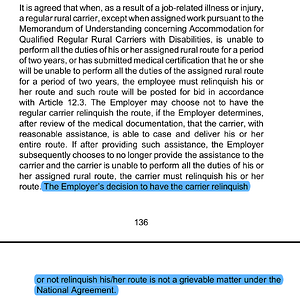
- Are the parties involved in a Step 1 discussion permitted to fashion and agree to a remedy of a grievance that is inconsistent with unpublished, Headquarters-level interpretations of Postal rules?
- Are the parties involved in a Step 1 discussion restricted from fashioning and agreeing to a remedy of a grievance that is inconsistent with unpublished, Headquarters-level interpretations of Postal rules?
-
This is not a grievance, either. Sweetheart Deals are frowned upon but what is agreed to at the discussion is between mgmt & carrier. If that decision harms or effects other carriers in any way & is a Contract Violation, that Violation can be grieved by the offended party.
On the contrary, it is. It meets all the necessary conditions of the definition of grievance. Each of these seeks the limits of remedies.
"Sweetheart deals" are not just an inconvenience frowned upon, they're a form of direct dealing, which is unlawful.
Article 16 restricts employees from violating the terms of the agreement. If I cannot require interpretations, then I risk discipline for ignorantly striking a sweetheart deal.
The definition of grievance permits the union rep or any employee who has an issue with the sweetheart deal to pursue a stop to it.
Does Article 31.2 allow for the union’s request and retrieval of the employer's interpretive position over any general or specific rule covered under the scope of the National Agreement?
This is also not a grievance against mgmt. If the Union has issues with mgmt providing RFI documents or information, the Union can file on that issue alone if necessary and take it to the Labor Board if necessary.
Incorrect. This issue also satisfies all conditions which defines a grievance.
While I agree with you that the union can grieve on 31.2, there is no rule that clearly and unequivocally restricts
employees from grieving 31.2 violations.
is not a grievance.
This section of the National Agreement pertains to complaints against mgmt, not the Union. It is clearly stated their that it needs to be related to wages, hours, or conditions of employment.
A question of clarification of mgmt & the Union’s position on subject matter is not a grievance.
- Grievance issues are written in the form of a question in box 4 of the 8191.
- "Clarification" and "interpretation" both require an interpretive act.
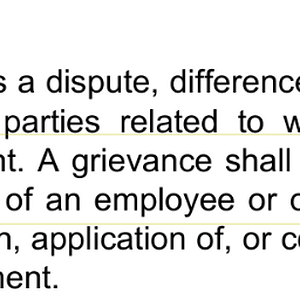
- When the union's interpretive position does not match the employer's interpretive position there exists an interpretive difference. The definition of a grievance includes "differences". That subject matter is open to grievances in order to resolve the difference.
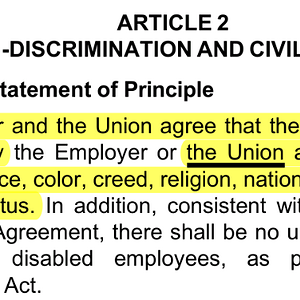
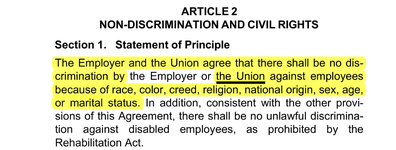
Article 2.1 permits grievances over the union's discriminatory practices against employees. Grievances aren't limited to complaints against management violations; there are a few stated obligations in there that the union has to uphold. Below is just one of them.


 DR
DR