U caught my attention
Well-known member
@LouSainus
Contact your DR about this issue.
Contact your DR about this issue.


The examples listed are directly copied from the old mail counts examples. The actual answer doesn't say anything about sacks or containers. It just says enter the number of items that qualify on that list. The old mail count language shouldn't be a reference for the newer system. My understanding is the intent of the sacks thing was so carriers picking up sacks of mail without barcodes still received credit. The 2020 count guide says sacks count as 1 unless we have to scan the items then we get that column as full item count creditFrom RRECs Q & A
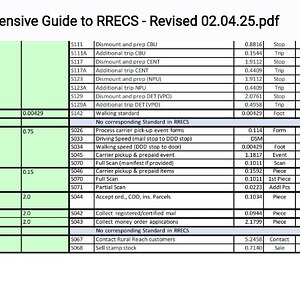
87. When doing a carrier pickup under the RRECS do we scan every package that we pick up? Please clarify theuse of the CARRIERPU entry.
A. There are two events that qualify for the credit provided using the CARRIERPU (Hot Key “O”) entry;
1) Carrier Pickup notification
and
2), acceptance of prepaid parcel over 2 lbs. not associated with carrier pickup.
If both events are performed at the same address, CARRIERPU is used only once.
Carriers are not required to go to the customer’s door to collect mail for any reason other than a carrier pickup request, which should include at least one qualifying piece
(Priority Mail Express, Priority Mail, First-Class Package Service, Priority Mail Express International, Global Express Guaranteed, Priority Mail International, Returns (USPS Return Service: First Class Package Return Service, Priority Mail Return Service and Ground Returns; Parcel Return Service; and Merchandise Return Service), Parcel Select Ground, USPS Retail Ground, and other packages.)
The CARRIERPU entry will be made even if the official pickup request results in no qualifying pieces being collected. The MDD is being updated to accept “0” as the number of pieces
accepted.
In those instances when management directs the rural carrier to accept/collect these items,
or the customer leaves a note in the mailbox requesting such service,
or where there is an understanding between management and the carrier that a specific customer has a standing order to have items collected each day or on specific days,
the route will be credited by using the CARRIERPU entry.
Each event will be recorded using the CARRIERPU entry.
The number of pieces collected is then counted and entered.
Count and enter each mail piece that qualifies in accordance with the list above and any Prepaid Parcels over 2 lbs.
Other mail pieces accepted/collected at this time, such as obvious letter and flat-size mail, including small parcels, should not be included in this count. The Carrier will then scan the first 5 qualifying mail pieces collected. If a Customer Manifest (Form 5630) is presented, the carrier should scan that form using the PRE-Paid Acceptance Scan in the on-street menu. The MDD is also being updated to allow for a CARRIERPU entry even when no parcels accepted have barcodes.
If the carrier is instructed to scan more than 5 parcels accepted as part of Carrier Pick Up, the Pre-Paid Acceptance scan should also be used for all parcels beyond the first 5. When mail pieces with a barcode are collected on the route- out of a mailbox or collection box, the Pre-Paid Acceptance scan should be used.
Ref: Letter of Mutual Understanding 2-24-14; and Publication 399, February 2019, p30
The following examples are intended to assist with the understanding:
Example 1: If management approaches the carrier in the morning and instructs the carrier that John Doe at 123 Main Street has a curbside box, has items that need to be picked up at the door. The carrier gets to 123 Main Street and collects 20 priority flats, 10 priority boxes, 7 first class small parcels that weigh 2 lbs. or less and 2 parcels that weigh more than 2 lbs., the carrier will use the CARRIERPU entry at the address and would enter the parcel quantity as 39 and scan the first 5 items collected. If directed, the carrier would scan the remaining parcels using the Pre-Paid Acceptance Scan. This example would also apply to a note left in the box from a customer and any standing orders that have been discussed between the carrier and the manager.
Example 2: If the carrier arrives at a box where no carrier pickup request was made and there is mail in the box to be collected and the following items are in the box: 6 priority flats, 4 small priority boxes less than 2 lbs., and 1 prepaid parcel that weighs more than 2 lbs., the carrier will use the CARRIERPU entry and enter one (1) in the number of parcels. The remaining pieces collected would be scanned using
the Pre-Paid Acceptance Scan. This example would also apply to individual pieces collected at a business where the carrier is authorized an official dismount.
It is improper for a customer to request through Carrier Pickup, call the Manager to request a pickup, or leave a note in the box to pick up items at specific location, when they do not have any qualifying pieces (Priority Mail Express, Priority Mail, First-Class Package Service, Priority Mail Express International, Global Express Guaranteed, Priority Mail International, Returns (USPS Return Service: First Class Package Return Service, Priority Mail Return Service and Ground Returns; Parcel Return Service; and Merchandise Return Service), Parcel Select Ground, USPS Retail Ground, and other packages.) If this occurs the carrier should discuss this with their immediate Supervisor who should in return discuss with the customer. This service is only provided when there are qualifying pieces.
There will only be one CARRIEREPU entry per address.
A sack of pre-paid parcels collected is entered using the CARRIERPU entry and the number of parcels collected as one (1). If the carrier is required to scan items contained in the sack at the delivery point, the carrier would use the Pre-Paid Acceptance Scan. If the carrier is required to empty the sack upon return to the post office, additional credit is provided as actual time in End of Shift Duties.
If a carrier accepts a pre-paid parcel, Merchandise Return Service (MRS) or a Parcel Return Service (PRS) over 2 lbs. atthe mailbox or at the delivery point (such as a business where a dismount and distance is provided) the carrier will use the CARRIERPU entry, enter the number of parcels collected, and scan the first 5 items collected.
That's everything from #87 of the QA. I will note that USPS Retail Ground was consolidated into USPS Ground Advantage in July 2023, so I would assume that is grandfathered into the lists above.
How the event is triggered determines how many items you get to put into your count.
If you have customers with regular pickups and management understands this, then that event qualifies as if they gave you a slip and you count/scan it as dictated above.
Driving up to a random box with flag up or a customer handing you a package, the 2 lb rule applies.
There's language here about sacks specifically, not sure how tubs would count. I personally would assume that if you are replenishing their supply of tubs in exchange then it's as if you did the pickup rather than tossing a sack into your vehicle, but if you just toss the tubs into your vehicle then I think you would enter the number of tubs you picked up and not the total package count as you aren't truly handling all of the packages which is what the 'count compensation' is supposed to be for.
The sacks are mentioned and it mentions scanning as prepaid acceptance. This is from the RRECS QandA not sure what old count stuff you're referring to as I didn't pull any of this from that.The examples listed are directly copied from the old mail counts examples. The actual answer doesn't say anything about sacks or containers. It just says enter the number of items that qualify on that list. The old mail count language shouldn't be a reference for the newer system. My understanding is the intent of the sacks thing was so carriers picking up sacks of mail without barcodes still received credit. The 2020 count guide says sacks count as 1 unless we have to scan the items then we get that column as full item count credit
This is travesty . It cannot standManagement is now requiring all pickups to be credited as containers. For example if you pickup a tub of parcels it counts as 1 item or if a customer has a cart they load them in and you roll it to your vehicle its 1 item. They are also requiring carriers to bring tubs to pickups not in containers and we load the parcels into the tub and then only receive credit as 1 item since its in 1 container now. Regardless if we have to scan the items they are saying its the number of containers since the scanner says enter the number of packages/containers picked up(physically) for the RRECS O function.
Ive gone through a ton of documentation on this and nothing says anything about containers except a few posters but actual contracts or MOUs dont say this. The old mail count which was removed from the contract used to say sacks of prepaid parcels count as 1 unless we have to scan the items inside.
Additionally they are also saying we only get credit for items if they weigh over 2lbs. Which is also in the old mail count. We dont have scales to weigh items and credit is applied through the scanner at acceptance.
The union is saying we get full credit for all items picked up during a carrier pickup event and the prepaid 2lb thing is only if pulling an item from a mailbox or its just prepaid acceptance if under 2lbs.
What's the actual contractual wording on the containers? It can be an MOU or contract or a handbook. The PUB 399 was updated to have everything scanned as accepted but do we get rrecs O item credit for that plus H prepaid credit?
Wait, you missed the point@Augsburg
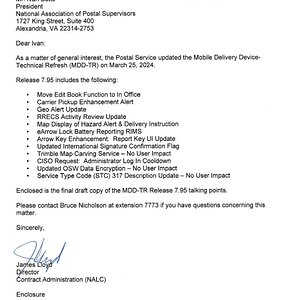
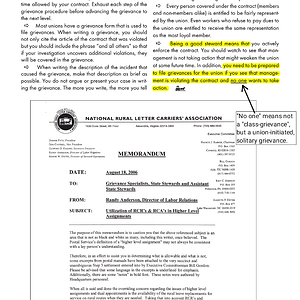
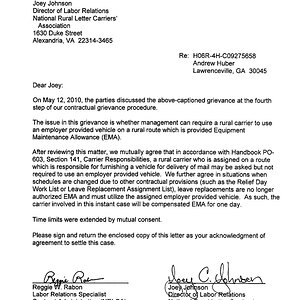
That letter is signed by the Director of NALC.

The examples from the rrecs q and a question are directly copy pasted from the examples in the 2020 mail.coubt guideThe sacks are mentioned and it mentions scanning as prepaid acceptance. This is from the RRECS QandA not sure what old count stuff you're referring to as I didn't pull any of this from that.
I am trying to find that Bradley document. This pickup thing has escalated a lotThe confusIng part to me is in Bradley pick- ups are defined as a piece count. If they change that, more pkgs will be in the pipeline than accounted for. Those same packages will eventually receive delivery as an individual piece. With them wanting sometimes container AND sometimes piece as the unit, we will get 1 credit but that one container could have 10 pieces in it. Some of us will be counting pieces. The unit needs to be clear with a time standard because actions matter. This is purposeful manipulation of volume with the pick up standard, and contrary to rrecs procedure. Rrecs is what they want to use to determine our cost and product cost. There are only 9 piece counts listed in Bradley. Another example of a standard time with a piece count is verify address. We handle each individual piece to verify address. Why are they not allowing us to perform the task of handling each piece at the pick up packagelocation ? We cant very well use rrecs as an analytical costing method if the procedures are not clearly defined, followed properly and everyone is trained on them.
Garbage in = garbage out
For those out there with lots of experience, how do training manuals get made? Is it a joint effort between the parties?
Sorry, this topic hit a nerve with me and I went on a tangent that isnt going to be helpful to you in this regard.I am trying to find that Bradley document. This pickup thing has escalated a lot