Neither the order of consideration document nor Article 30.2.D.6 declare "any employee", but instead specifically states, "another qualified employee".
- The Employer is limited by Article 3 (Employer Rights). Under Article 3.f (Management Rights), management has the exclusive right—subject to the Agreement and applicable laws—to take whatever actions are necessary to carry out its mission in emergencies.
- That authority cannot be stretched beyond the Agreement itself. Article 37 (Scope of Agreement) specifically identifies that the current contract is the complete and exclusive agreement between the parties; it fully defines their rights and obligations.
- Because the National Agreement does not apply to employees in other crafts (Article 1.2.f – Exclusion), the Employer cannot extend its terms to those employees, even during emergencies.
- Therefore, when applying Article 30.2.D.6, the Employer may not designate an employee from another craft.
It appears your position is that (and please correct me if I've misunderstood) the individual management designates as "qualified" becomes "qualified" by nature of being selected. I.e., whatever employee management selects to perform bargaining unit work under 30.2.D.6 becomes
automatically qualified because management declared it so.
If I am accurately reflecting your position, here's why I disagree.
A qualification, by definition, can never be met without satisfying its prerequisites. If management's
designation of an employee were the only prerequisite, then the word "qualified" would be superfluous. The phrase, "...
another qualified employee may be designated by the Employer." would be the equivalent to,
"...another employee may be designated by the Employer."
Article 30.1.P is currently modified by the August 15, 2025 MOU
- Article 30.1.P - A regular rural carrier shall not be required to serve all or part of any rural route other than his or her assigned route except as provided in ELM, Section 546 [, Reassignment or Reemployment of Employees Injured on Duty].
In that MOU, management must exhaust or waive authority of 30.2.D.6
before applying the MOU.
View attachment 16784
Under the theory that 30.2.D.6 permits management to utilize other craft employees to perform bargaining unit work, the MOU would grant management the right to place other bargaining unit craft employees on rural craft bargaining unit work
before utilizing all members from assigned bargaining unit craft. I.e., the union would have agreed to grant non-craft precedence to craft work over the craft it represents, at management's discretion.
Not if it's resolved at discussion.
Under the theory that management can utilize non-craft employees at 30.2.D.6, I'd agree. If not though:
- Management violated the MOU by utilizing an ineligible employee to perform bargaining unit work while the elegible grievant was available, interested, and willing to volunteer, had management provided the option to the elegible grievant rather than the ineligible employee.
Which brings me back to the original question;
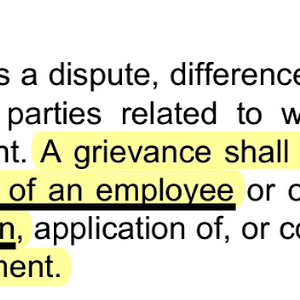
Are rural craft employees not permitted access to the grievance procedure in relation to complaints involving interpretation of the National Agreement?
Take this issue with 30.2.D.6, if the answer is one of these two theories (or some third theory neither of us touched on), presuming access to interpretive grievances are permitted, how would one phrase an interpretive grievance (on this or some other interpretive question) to get the answer in writing?