• Everyone, please help make our jobs easier and choose the correct category. Thank you

RRECS Interim Worksheet

stingrayiii

Well-known member
Just saw the new official interim worksheet that was available to use starting today.
It is a excel file just like the old one before it, but a little more complicated.
Everything still has to be done by hand to figure out the adjustments. No AI to help, no just clicking address to migrate them over, ect.

I see to many problems arising from this.

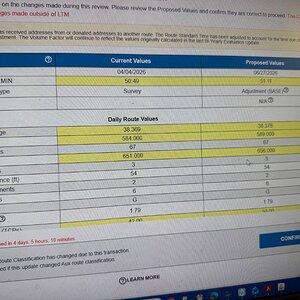
There are still columns for mileage, parcel lockers, deliveries, ect.
These one standout the most to me.

It works the same way as before giving a volume factor for the whole route, not just certain neighborhoods. This is a separate column.
This will really screw with routes that are being involved. Say your overburdened and they take away your heaviest neighborhood. Well come next count your volume could drop really bad.

Load time calculation Column.
Takes your average load time, and averages it out to the new route it is going to. So say the overburdened Route has been taking 10 mins average, and the other Route the new territory is only taking 5 mins average. Well it calculates a new standard for the territory to the new route.
Many problems I see.
1. People that are purposely taking longer load times then they should (excessive). Now overburdened, and after the cut you go to a 43k. How do you justify long load times when you lost all that volume? I see many problems coming from this.
2. If one carrier can load faster then the other, this will affect the routes involved to move either way. Come next count it could be good or bad.

DPM Column.
The person doing it has to go through and mark the new stop lights/signs, crosswalks, ect.
Nothing big but still adds a lot more work to the person doing the adjustments.

---------------------------------------------------------------------------------------------

So the issue rises are this. If you have a person that takes their time and really goes over it and does it right, the routes will turn out ok.
But!!!!!!!! How many people are going to take the extra time and do it correctly, or are they just going to take whatever they make work and move it cause it "works"?

I see a total cluster #%$@ coming our way.
 
Exactly. Each mailbox has its own unique individual time value.

I'm going to do this and I strongly urge *demand* you follow my lead. RFI and FOIA request each boxes value for ALL routes adjusted.

NRLCA can't ignore facts. That's why they hate me. Don't give them an out. There's nothing fair or aligned with the engineers billion $ study scrutinizing every fine detail down to the 10,000th second. And yet here we are 2 MinUtEs a MiLe, 2 MiNuTeS duh BoX.
 
I've not even looked at the worksheet yet but for anyone that has, take your whole route and input the data on the worksheet and see what what the total time is that way and compare it to what RRECS says you are now. That "worksheet" does not know the difference between part of a route and all of a route.
 
Exactly. Each mailbox has its own unique individual time value.

I'm going to do this and I strongly urge *demand* you follow my lead. RFI and FOIA request each boxes value for ALL routes adjusted.

NRLCA can't ignore facts. That's why they hate me. Don't give them an out. There's nothing fair or aligned with the engineers billion $ study scrutinizing every fine detail down to the 10,000th second. And yet here we are 2 MinUtEs a MiLe, 2 MiNuTeS duh BoX.
What is Friday and Toia? I am being cut approx ;7 min. As of today losing 48 boxes and 2. Something miles. Less than a min per box. This spreadsheet is unbelievable. So from 47k to 43 k and who the heck knows after that? Sooo disappointed
 
What is Friday and Toia? I am being cut approx ;7 min. As of today losing 48 boxes and 2. Something miles. Less than a min per box. This spreadsheet is unbelievable. So from 47k to 43 k and who the heck knows after that? Sooo disappointed
Rfi and foia? Dang autocorrect. Asked for what each box is supposed to account for and nada
 
Exactly. Each mailbox has its own unique individual time value.

I'm going to do this and I strongly urge *demand* you follow my lead. RFI and FOIA request each boxes value for ALL routes adjusted.

NRLCA can't ignore facts. That's why they hate me. Don't give them an out. There's nothing fair or aligned with the engineers billion $ study scrutinizing every fine detail down to the 10,000th second. And yet here we are 2 MinUtEs a MiLe, 2 MiNuTeS duh BoX.
Each box does not have a value which is why the routes being adjusted up or down are being “frozen”. If they could use a value then it wouldn’t be an issue at the MMS for the next 2.
 
I've not even looked at the worksheet yet but for anyone that has, take your whole route and input the data on the worksheet and see what what the total time is that way and compare it to what RRECS says you are now. That "worksheet" does not know the difference between part of a route and all of a route.
Different volume factor applied to each individual box or the same volume factor applied to all boxes. Formulas for mileage. It's all math. So is any of it accurate? Dps? Coverage%?
The only true accuracy is hourly. It takes what it takes. Paid for all work actions.
However, I still benefit and am for evaluation.
 
Different volume factor applied to each individual box or the same volume factor applied to all boxes. Formulas for mileage. It's all math. So is any of it accurate? Dps? Coverage%?
The only true accuracy is hourly. It takes what it takes. Paid for all work actions.
However, I still benefit and am for evaluation.
Same volume factor is utilized on each address. The mileage averages at 3 minutes per mile since there is no way to calculate the intervals until they are driven. DPS is already factored into the volume factor. Coverage doesn’t play here since they don’t have a separate coverage for each address.
It's very similar in the way adjustments were calculated before RRECS.
 
It’s an older way of doing adjustments tangled with RRECS. It’s what our union agreed to, to address overburdened routes. System doesn’t know what your moving only the adjuster does once they create new edit books for routes.
 
Same volume factor is utilized on each address. The mileage averages at 3 minutes per mile since there is no way to calculate the intervals until they are driven. DPS is already factored into the volume factor. Coverage doesn’t play here since they don’t have a separate coverage for each address.
It's very similar in the way adjustments were calculated before RRECS.
I guess my point was missed. I don't want to derail the thread. Of course, I know DPS is in Volume Factor.
I suppose most routes will be close to the 3 min/mile avg. I've seen some in the low 2's. It will be calculated for each route.
Coverage does play. They are not going to give us 100% credit like old adjustments. Look at the Blank V18 Interim Adjustment Worksheet on the NRLCA website.
There is a reason coverage % is to be entered.
Box Time = Boxes x Volume Factor. This Box Time is not used in the Adjusted Box Service Time formula.
Adjusted Box Service Time = Boxes x Box Time x Coverage % x 6
Box Time would depend on bundle type and box type. Coverage would depend on Reg or Central.
So each box will be Box Time+ Adjusted Box Service Time
If a route is gaining boxes, that route uses it's own coverage factors for the new boxes.
I believe loading time is just loading time/# boxes= avg. loading time per delivery
 
Last edited:
I guess my point was missed. I don't want to derail the thread. Of course, I know DPS is in Volume Factor.
I suppose most routes will be close to the 3 min/mile avg. I've seen some in the low 2's. It will be calculated for each route.
Coverage does play. They are not going to give us 100% credit like old adjustments. Look at the Blank V18 on the NRLCA website.
There is a reason coverage % is to be entered.
Box Time= Boxes x Volume Factor
Adjusted Box Service Time = Boxes x Box Time x Coverage % x 6
Box Time would depend on bundle type and box type. Coverage would depend on Reg or Central.
So each box will be Box Time+ Adjusted Box Service Time
If a route is gaining boxes, that route uses it's own coverage factors for the new boxes.
I believe loading time is just loading time/# boxes= avg. loading time per delivery
Shouldn't that be Boxes = Boxes PLUS Volume Factor For Box Time ? I still gotta look at the worksheet as I've not done so yet.
 
I guess my point was missed. I don't want to derail the thread. Of course, I know DPS is in Volume Factor.
I suppose most routes will be close to the 3 min/mile avg. I've seen some in the low 2's. It will be calculated for each route.
Coverage does play. They are not going to give us 100% credit like old adjustments. Look at the Blank V18 Interim Adjustment Worksheet on the NRLCA website.
There is a reason coverage % is to be entered.
Box Time = Boxes x Volume Factor. This Box Time is not used in the Adjusted Box Service Time formula.
Adjusted Box Service Time = Boxes x Box Time x Coverage % x 6
Box Time would depend on bundle type and box type. Coverage would depend on Reg or Central.
So each box will be Box Time+ Adjusted Box Service Time
If a route is gaining boxes, that route uses it's own coverage factors for the new boxes.
I believe loading time is just loading time/# boxes= avg. loading time per delivery
That is the old Interim Adjustment Sheet from last year. I will admit that I didn’t look at it to see what had changed from the earlier version that didn’t account for much at all.

There is a new one that was just released within the past 2 days. I do not know what has changed, though.
 
That is the old Interim Adjustment Sheet from last year. I will admit that I didn’t look at it to see what had changed from the earlier version that didn’t account for much at all.

There is a new one that was just released within the past 2 days. I do not know what has changed, though.
Looks like not much. It is still an excel file. The one I saw was just released. I'm just amazed that they couldn't make a program to migrate everything over.
 
That is the old Interim Adjustment Sheet from last year. I will admit that I didn’t look at it to see what had changed from the earlier version that didn’t account for much at all.

There is a new one that was just released within the past 2 days. I do not know what has changed, though.
The NRLCA's version is a pdf. I'm sure the Excel version has many formulas to account for the components of our evaluations. All the data used in the formulas can be in hidden cells/columns. Doesn't need to be seen. So the worksheet can appear to be incomplete in either format.
 
Last edited:
Back
Top