• Everyone, please help make our jobs easier and choose the correct category. Thank you

About to start a new RCA position in an area with very high turnover- what's going on?

<blockquote class="spPostEmbedQuote"><strong>MiddleOfNowhere said </strong>
Retention rates for RCAs are around 65% - that is a very deceiving statistic - i  have no idea how many rca's we currently have, but say we have 30,000 rca's at a given time.  we hire 10,000 more in a given year.  a possible 40,000 now employed, but we only retain 65% after the year is up.  40k x 65% = 26,000.  stats can be twisted any number of ways. but actually, that sounds about right...  </blockquote>
Figures lie and liars figure.

When 34.8% is the target turnover rate things are screwed up from the start.
 
EthylAnne -- " upthread"  had not heard of the before, but appropriate - thanx.

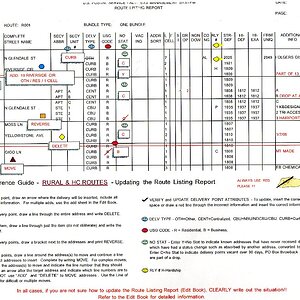
--  Route Maps -- if inaccurate or incomplete or not even in the route book -- that falls mainly on manglement and also on the route carrier.   The PO-603 spells out specifically what should be in the route book - page 41.  Sometime one has to take matters into one's own hands.

--  Really no excuse for a not having a decent map, especially with Google Maps readily available.

--  In my RCA days in the latter part of the last century, if I didn't like the route map on a new route, I'd make a new one -- usually with more details.   One of the other RCA's happened to show the PM one of my maps.   Apparently he liked it as he tasked my to redo all the city and rural route maps.   All the grade school training with scissors and pasting paid off as I worked a lot that summer when route work as scarce.

--  Even made up 3 binders containing all the city and rural maps.  Those were used by RCA's running Express Mail -- back in the better times.
 
<strong>BrandNewRCA said </strong>
"New hire here just attempting to sift through the peculiar experience that has been my training and orientation. There seems to be a very pervasive assumption that I am going to quit the position. I've been told by every employee/manager/instructor that the job is hard and extremely overwhelming. It's unlike any other hiring/training experience I've encountered. They've apparently implemented a new program to try and remedy CCA & RCA complaints about lack of prep, however it still has included hardly any actual prep for on the job work. A lot of it seems to be preparation for fighting with managers and supervisors. Things like, "They're going to ask you to do A, B and C, but those aren't your job so don't let them do that." Well, uh, shouldn't you be talking to them about that?"

---- Ok. First off, the job is very overwhelming. I've seen people break down and cry. Not kidding. The new program comes in with the on the job training. The orientation you went to was essentially to get you in the system so that you can be paid, so your background check can be completed, to show you very outdated videos concerning how to not steal, and to start drilling into you the importance of safety. These lessons take time to complete. Yes management will try to make you do things that you don't have to do. I wish someone would have given me that heads up. Took me a few months to figure out exactly what was and what was not my job.

"I still haven't received a definite set of instructions for how to perform the job itself. I figured there'd be a binder with clear instruction on check in procedure, the order of events, a map of the route with a list of addresses that could be easily followed. The job shadowing day was the most enlightening, and was the first practical chunk of information I've received despite a painful 40+ hours of training I've already been through. What in the heck are these folks doing?  I've driven my own vehicle 3 hours to training sessions at 7am with no offer of compensation for my gas or time spent commuting. I have also not been consulted at all in the scheduling of my training, often being informed 1 or 2 days prior that I am expected 140 miles away. All for training sessions that are mostly powerpoint and DVD based and easily could be conducted online or on site at the job. I've been doing the run around for three weeks and haven't been paid."

-- Your on the job training (in office) is supposed to be where you learn the real nuts and bolts of the job. I mean different offices are set up and run differently, so an academy trainer can't really show you the little things (like where the DPS is, because some offices distribute it to your case, while others put it in a central location, and others don't have DPS to begin with). Check in procedure: walk in, go to your case, grab the time sheet, and write what time you arrived on it. Simple as that.

-- As for the route map, yeah that'd be nice. If you're lucky, your route has a complete and accurate Form 4003 (Route information with a list of turn by turn directions). The last 2 days I've been learning routes without a decent 4003. Thankfully Google knows where things are.

-- Compensation: Sometimes you have to "remind" management about compensation. In this case, you should be paid approximately $.53 per mile through eTravel. It's entirely wrong that you sometimes have to fight to get paid, but it's the nature of the beast.

-- Training online or on site: If they did that, they couldn't confirm that you were actually watching the videos. In the office someone would have to continually be checking in on you and dealing with that system when they have so many other things to do. If you think things were missed at orientation and academy, just imagine what an overworked manager would miss.

-- Short notice: Yup. That's how this place operates. The schedule is fluid, especially for subs. One day we look at the schedule for next week and see nothing for ourselves to do. And then out of the blue we're working well into OT. That's what being a sub is like.

"If this is their corrected and improved program, I can only imagine what previous hires had to go through. I'm not the type to quit something because it's hard, and I have no intention of leaving. I understand it's a huge company and trying to coordinate such massive hiring is difficult. But the glaring inefficiencies are not setting a great tone. Not once has someone treated me like I am an important new member of a team that they are very keen on keeping around. It's not something I've ever experienced on previous jobs. I'm pretty darn qualified, I work hard and I don't complain on the job. Typically when I join a team, people are pleased I have done so. Not trying to sound arrogant, just don't want to come across as some whiny, entitled, lazy worker who balks at the idea of a stressful work environment. That's why this has been such uniquely frustrating experience."

-- You are not an important member of the team, in reality. None of us are. Not subs. Not regulars. We can be replaced by someone tomorrow. If you want to be regarded as an important part of the team, you have to move well into upper management. Until then, you're replaceable and there's definitely someone waiting for your job. I don't mean to sound so harsh, but again, it's the nature of the beast.

-- Glaring inefficiencies: Yup, you work for the government now. This morning I had to attend a meeting with 2 other RCA's and 2 people from district management. Those district managers make well over 100k and have the job of going around and going over safety practices, begging us to call them and not OSHA if we spot serious safety issues, and telling us how to move up in the organization. That 40 minute meeting easily cost the PO $800 by the time they paid the RCAs and the managers, their mileage, and 3 boxes of donuts. That's how government works.

"To sum up a wordy message, I am glad to have found a site where I can vent my frustrations without fear of repercussion or of losing respect among my coworkers. If anyone has any insight or tips for a new RCA, it'd be much appreciated."

-- Tips: Use this site. There's a tips and tricks article somewhere. I think it's in the knowledgebase.


EDIT: <a href="https://knowledgebase.ruralinfo.net/kb/tips-techniques-for-new-rcas/">Here's the link to the tips and tricks page</a>
 
<blockquote class="spPostEmbedQuote">
<strong>btdtret said </strong>
EthylAnne -- " upthread"  had not heard of the before, but appropriate - thanx.

--  Route Maps -- if inaccurate or incomplete or not even in the route book -- that falls mainly on manglement and also on the route carrier.   The PO-603 spells out specifically what should be in the route book - page 41.  Sometime one has to take matters into one's own hands.

--  Really no excuse for a not having a decent map, especially with Google Maps readily available.

--  In my RCA days in the latter part of the last century, if I didn't like the route map on a new route, I'd make a new one -- usually with more details.   One of the other RCA's happened to show the PM one of my maps.   Apparently he liked it as he tasked my to redo all the city and rural route maps.   All the grade school training with scissors and pasting paid off as I worked a lot that summer when route work as scarce.

--  Even made up 3 binders containing all the city and rural maps.  Those were used by RCA's running Express Mail -- back in the better times.  

</blockquote>
@btdtret I'm talking about the four day training program in the academy. It's not realistic to expect the academies to have (and maintain) route maps for all the routes in the United States Postal Service, or even all the routes in a district. I'm not even sure if the trainers could even find out what route the RCA has been assigned, so it's all around an unrealistic expectation, but a brand new RCA would not know that. 

Of course accurate route maps should be in place in each office.
 
And one more thing: @heyman1104 's post is spot on in all respects. This job is not for everyone, but it's the best paying one you'll find for unskilled labor in this country right now, I think. If you're looking for pats on the back and gold stars and employee appreciation dinners, you're not going to find that in the USPS, at least not at this level of the organization. 
 
EthelAnne -- "I’m talking about the four day training program in the academy. It’s not realistic to expect the academies to have (and maintain) route maps for all the routes in the United States Postal Service, or even all the routes in a district."

--  Okay, my bad.  Thought you were describing what to expect when getting to the actual post office assignment.   At least the Academy could show examples of a good route map ( lots of details:  route #,  line of travel marked by arrows, street names labeled, location of Blue Mail Boxes, address number for businesses / strip malls, rail road track crossings, etc ).   While an example of a bad route map would be one that looks like a stick figure with few, if any details.
 
@BrandNewRCA The best tip I can offer is once you get your feet wet, educate yourself.

Avail yourself of the wealth of info on this site, become familiar with the contract and learn the PO-603 (available on the knowledgebase of this site and there should also be one at your case) frontwards, backwards and upside down.  It tells you how you should be doing your job.  I wish my sub would read it.  :p

Good luck and welcome to the service!
 
BrandNewRCA -- "EDIT: <a href="https://knowledgebase.ruralinfo.net/kb/tips-techniques-for-new-rcas/" target="_blank">Here’s the link to the tips and tricks page</a>"  A big tip of the hat to RI for those.

--  Regarding those tips and tricks --

--  Print them out and send a copy to the Academy personnel.

--  IMHO -- "<strong>Efficiency</strong> comes with time" might have been a better choice of wording.

--  Adding to that list:

--  Storing items on the LLV's sun visor -- some post offices require EVERYTHING be removed from the vehicle at the end of the day

--  If you are in snow country -- carry an emergency bag of extra clothing, food, water, radio, flash light, survival blanket, etc as manglement won't have a problem sending carriers out when blizzard conditions are forecast -- or happening.   Ask manglement for sand bags or other heavy items to put over the rear axle for better traction.   Manglement may consider a snow shovel as a "missile hazard" ( while ignoring the trays of mail and parcels ) and refuse to provide one.   Provide your own.   Pieces of card board or strips of plastic mesh come in handy should you get stuck.   If you are really stuck, call for assistance instead of trying to drive your way out.   Over the past few years, several LLV fires have resulted when carriers tried to rock back and forth to get unstuck.   Have a bail out plan in place should you see smoke coming from under the hood!!  That applies to all seasons.   If the LLV number begins with a "4", be ready!

--  Check the work schedule regularly as changes may occur -- even after you have gone home.   That's why schedules are done in pencil.

--  Some post office are strict on copier usage so you may have to get permission to make a copy of the 4240.    Manglement can fire you for just about any ole reason during your probationary period ( 90-work days or 1 year, which ever come first ).   Don't get fired just for making an unauthorized copy.

--  LLV's -- when you have the route, it is "your route and LLV' -- for the day, just like being the regular carrier for the route.   Try to leave the mirrors or at least the seat as you found them.  The smallest of things can create big problems between a regular and a sub.  The check of the vehicle first thing in the morning includes adjusting mirrors and the seat.   

--  Phone numbers:   add 1-800-ASK-USPS, as manglement would rather have customers call that number instead the local post office number.   The customer will eventually be routed to the local office, but probably manglement hopes that the customer will give up.   Phone numbers for the USPS OIG and Postal Inspectors might be requested by a customer.

--  Make a small bag / container for 3949's, change of address forms, stamps, coins, pens, etc.   Customers will appreciate the service if you have what they need on hand.

-- Just like each post office is different, each carrier has her / his own system that has taken years to perfect.  Observe the way others case mail, mark parcels, pull down and load mail trays, load and set up their vehicle ( POV or LLV ), etc.  Usually RCA's will copy what the regular does, but don't be afraid to try different ways until you find one that "works" for you.

--  To avoid the problems of replacing what ever is in your wallet / purse, leave them it your locker and carry the bare essentials like a driver's license and small amount of cash / coins.

--  Working for the USPS is a never-ending learning process.
 
<blockquote class="spPostEmbedQuote"><strong>EthelAnne said </strong>
<blockquote class="spPostEmbedQuote">
<strong>btdtret said </strong>
EthylAnne -- " upthread"  had not heard of the before, but appropriate - thanx.

--  Route Maps -- if inaccurate or incomplete or not even in the route book -- that falls mainly on manglement and also on the route carrier.   The PO-603 spells out specifically what should be in the route book - page 41.  Sometime one has to take matters into one's own hands.

--  Really no excuse for a not having a decent map, especially with Google Maps readily available.

--  In my RCA days in the latter part of the last century, if I didn't like the route map on a new route, I'd make a new one -- usually with more details.   One of the other RCA's happened to show the PM one of my maps.   Apparently he liked it as he tasked my to redo all the city and rural route maps.   All the grade school training with scissors and pasting paid off as I worked a lot that summer when route work as scarce.

--  Even made up 3 binders containing all the city and rural maps.  Those were used by RCA's running Express Mail -- back in the better times.  
</blockquote>

@btdtret I'm talking about the four day training program in the academy. It's not realistic to expect the academies to have (and maintain) route maps for all the routes in the United States Postal Service, or even all the routes in a district. I'm not even sure if the trainers could even find out what route the RCA has been assigned, so it's all around an unrealistic expectation, but a brand new RCA would not know that. 

Of course accurate route maps should be in place in each office.  </blockquote>
The subs know what route they are going to when they go to Academy. The 'shadow day' is on the route they will be servicing and they could get a copy of the 4003 on that day. These newbies get a whole lot more training than we did; 3 days of 'good start(?)', then 3 days OTJ training which was 1 day together and the following 2 splitting the route, then nothing but 'Good luck!'. I did get some assistance from other subs when needed on routes I'd never done, but that was it.

My sub got a 'shadow day', all the Academy & LLV training, AND 5 days of OTJ. He still misdelivers mail to wrong names and/or wrong addresses. He doesn't care to do the job right, it's a paycheck and I wouldn't be surprised if he milks the clock since he is Still in his '5 PP of actual time'. 
 
<blockquote class="spPostEmbedQuote"><strong>MiddleOfNowhere said </strong>
i just got done training a rca the last couple of days.  she said, that her instructor told the class, that of the 12 new rca's there, that only 2 would still be working in 60 days, and the odds that anyone would be employed by the po in one year, was zero.   not exactly a pep talk, but probably what they have seen in the last few years.   it kind of points to some sort of deficiency in the hiring and training process - at least to this casual observer...

is a change needed?   well, expecting different results with repetition, is insanity...  </blockquote>
 

Perhaps what the instructor said is true, but that is a sad commentary on someone who is in a postion to deal with new hires.
 
Instructors and trainers tell new hires there is a good chance they are going to quit and it gets in their heads and will make them more likely to quit. If new hires are already on this site as a way to "vent" all they are doing is bitching about how hard it is and how they don't get adequate training so good riddance. I have no qualms when someone has an actual question or doesn't understand something about the job, but if they are already unhappy wait until they have to deal with manglement, shitty clerks and all the unethical stuff that goes on. I'm willing to bet some posts on here are started by long time employees just trying to get people stirred up and see what kind of responses they get, I'm not saying this is one, just in general.
 
In response to @heywood's statement, I can honestly say that in my few years, the best training method I've seen (as far as OJT goes), was to have the sub come in and case a few days in a row for a few hours. Then have them come in and case and carry mail (no big parcels) while someone else runs the big parcels out. Give them help delivering as needed. And then finally to hand them the full route. I think we could shorten up or even skip academy and spend that money with this sort of OJT. JMO.
 
PastOThirty -- " everyone should start as a “mail handler apprentice” and progress or branch to either clerking or carrying, or remain content to progress as a mail handler.  In order to be a a rural carrier, you would need so many classroom and practical hours as an MHA, as a clerk, as an apprentice mail carrier, and then as a relief rural carrier."

--  I'll have to say that is a novel idea.

--  On the other hand, I'd bet those MHA's up north and way down south would soon realize "I have an inside job -- don't have to go out in the accumulating snows and blizzard conditions and during the summer months, no driving around in portable sauna.  Think I will stay with the mail handler's inside job or maybe see what the clerk craft has to offer."   Probably a good chance the RCA "pipeline" will run dry sooner rather than later.
 
A new hire is obviusly an asset, if you do not invest wisely in your asset, you are wasting money on an asset that is not worth anything.


Based on the PO's retention rate of RCA's etc, it would appear the PO has yet to figure out how to maximize its labor force.
 
<blockquote class="spPostEmbedQuote"><strong>heyman1104 said </strong>
In response to @heywood's statement, I can honestly say that in my few years, the best training method I've seen (as far as OJT goes), was to have the sub come in and case a few days in a row for a few hours. Then have them come in and case and carry mail (no big parcels) while someone else runs the big parcels out. Give them help delivering as needed. And then finally to hand them the full route. I think we could shorten up or even skip academy and spend that money with this sort of OJT. JMO.  </blockquote>
If we could rely on individual offices to provide training, agreed, there would be no need for the training academy.

But I think we all know, without the academy training program, brand new hires would walk in the door and carry routes their very first day of work. 
 
At first having RCAs train at other positions first sounded plausible. 

But on second thought, I don't want CFS training how to handle forwards and markups. Get enough of that stuff back already. DEC means deceased, like dead, not DEC like decomposing. Yeah, they're still dead.

MHA... they could teach the RCAs to feed DPS upside down and backwards, then mix the mail and tags for several routes.

Clerks could teach RCAs to toss parcels, a useful skill when delivering.

204b could teach RCAS how to falsify timecards.

Transport drivers could teach how to be late for dispatch since they are so good at meeting arrival times.

Maybe clerks could show RCAs how to fill out 3849s. You know, like they are supposed to for restricted delivery.

I'm sure manglement could show them how to follow a years old out of date line of travel.
 
<blockquote class="spPostEmbedQuote"><strong>gotstamps said </strong>

The subs know what route they are going to when they go to Academy. The 'shadow day' is on the route they will be servicing and they could get a copy of the 4003 on that day. These newbies get a whole lot more training than we did; 3 days of 'good start(?)', then 3 days OTJ training which was 1 day together and the following 2 splitting the route, then nothing but 'Good luck!'. I did get some assistance from other subs when needed on routes I'd never done, but that was it.

My sub got a 'shadow day', all the Academy & LLV training, AND 5 days of OTJ. He still misdelivers mail to wrong names and/or wrong addresses. He doesn't care to do the job right, it's a paycheck and I wouldn't be surprised if he milks the clock since he is Still in his '5 PP of actual time'.   </blockquote>
I appreciate that's what going on in your office, @gotstamps. That's not what's going on in other offices.

Let me share the experience of the newest RCA in my teeny tiny 10 route (all rural) office with every single carrier having 20+ years of experience, except for the newest one, and that would be me, and I'm the union steward. Absolutely no one knew what was going on with that new RCA's training except for the PM and the regular carrier of the route she was assigned to up until the moment she got fired five months into her employment with the USPS (although, looking back on it, there were red flags out there for anyone to see).

While performing a cursory investigation of what went on, I learned that she got a shadow day on a route that would not be her primary assignment because the carrier on her primary assignment does not get paid to train RCAs, so refuses to do it. She cased bundles of standard mail only on her primary route (again, because that carrier would not train her) for her three days of training. She then worked Amazon Sundays and provided daily aux assistance delivering parcels  on the primary route from October until January. In April, that carrier on her primary route went on vacation for two weeks. One day into the second week, she got fired for insubordination when the PM initiated a discussion with her about performance inadequacies and she decided to give him an earful.

There's a lot of other stuff that happened here (including me approaching the RCA--as I've done with all new RCAs since I've been able to hold my own as a carrier--to help her case mail and her telling me she did not want any help unless I would deliver her packages for her that day) that's the fault of the RCA, but no way did her training set her up for success with the USPS.
 
<blockquote class="spPostEmbedQuote"><strong>Deer Smearer said </strong>
At first having RCAs train at other positions first sounded plausible. 

But on second thought, I don't want CFS training how to handle forwards and markups. Get enough of that stuff back already. DEC means deceased, like dead, not DEC like decomposing. Yeah, they're still dead.

MHA... they could teach the RCAs to feed DPS upside down and backwards, then mix the mail and tags for several routes.

Clerks could teach RCAs to toss parcels, a useful skill when delivering.

204b could teach RCAS how to falsify timecards.

Transport drivers could teach how to be late for dispatch since they are so good at meeting arrival times.

Maybe clerks could show RCAs how to fill out 3849s. You know, like they are supposed to for restricted delivery.

I'm sure manglement could show them how to follow a years old out of date line of travel.  </blockquote>
In addition to all this sarcasm (which I love), I'll add a couple of serious reasons: 1. Progressing through the different crafts is a violation of all the existing labor agreements and 2. I just don't need to know how to be a clerk in order to be a carrier. Would that stuff be nice to know? Eh, I dunno. I tend to think, and I think the original post on this thread supports that belief, that people want to know the stuff that will help them do the job they were hired for, not a lot of other stuff that may or may not be relevant.

In my perfect world, every office should have a designated trainer who receives additional compensation (money or time off) and trains all the new RCAs in the office on their route. The general concepts I learn on one route, should apply to all the routes. I don't need to know--not yet-- that on Route 31, you have to turn left at the old oak tree with the broken limb that looks like the number seven and on Route 9 I need to leave Mrs. Simmons' parcels in the green Rubbermaid container by her garage--I'll learn that eventually.

Throwback mail goes here, hot mail is here, this is how you set up your scanner, you deliver parcels to the door, DEC means deceased. Whether I'm on route 2 or route 14, that stuff is the same. There's a unique line of travel for all routes called the 4003, here's mine. Every route has its own peculiarities, here's mine, etc. 
 
EthelAnne et al -- Thanx for the view of what happened in your office.

" the carrier on her primary assignment does not get paid to train RCAs, so refuses to do it."

--  Maybe manglement could have told the regular " You don't want to train your sub, fine, she is no longer your sub.  She'll go to another route."  After all, the sub belongs to the USPS.

--  Don't know if manglement ordering a regular to train a sub is a legal order.  -- anyone??

" she got fired for insubordination when the PM initiated a discussion with her about performance inadequacies and she decided to give him an earful."

--  Well, good for the sub although it cost her a job.  Apparently the PM had no idea what kind of "training" the sub had received.

--  A good bet that the "earful" just went in one ear and out the other!

--  Did the sub finish her probationary period?

--  You probably should have suggested the sub write a letter to the PMG, describing her experience at the post office.   It would have been interesting to see in the PMG still holds to "keep RCA's at all costs."    The PMG "inviting" your PM to DC at his / her cost to explain what happened to the sub would have been interesting.
 
Back
Top