• Everyone, please help make our jobs easier and choose the correct category. Thank you

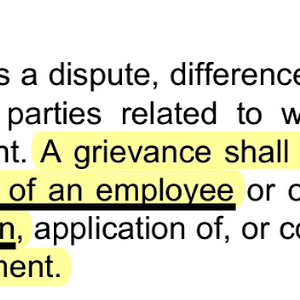
Are rural craft employees not permitted access to the grievance procedure in relation to complaints involving interpretation of the National Agreement

Qualified employees have been defined as ANY employee. I've seen janitors, HCR carriers, and pm's (The least Qualified to actually work).
Can you point to a source that supports this claim?

At no time has there been an agreement to allow Rca's to work over 12 (evaluation) hours.
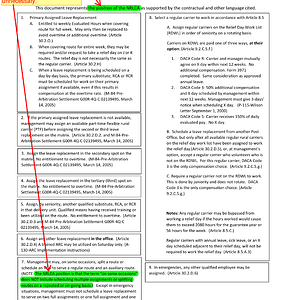
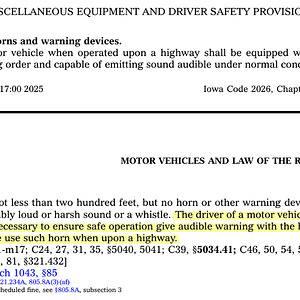
In G95R-4G-C00170298, the parties agreed to an exception to the general rule, permitting management to utilize leave replacements beyond 12 evaluated hours, but only in emergency situations.

[E]xcept in emergency situations, management must not schedule a leave replacement to serve on two full assignments or one full assignment and one or more partial assignments in a single day, if the evaluations of these assignments total twelve hours or more.

ezpdf.snapshot.48.png

The only other employees specifically permitted to perform bargaining unit work under the rural contract are supervisors.

ezpdf.snapshot.49.png

Although I have seen rcas that happily did "volunteer" to do so, for all of the extra overtime. During Covid times I knew an Rca that worked 92 hours in one week.
Now if you, as a regular, are grieving about an Rca working excessive hours, yes, there is "No violation", because it didn't happen to you.
  • The target of the "dispute, difference, disagreement, or complaint" in 15.2 are the "provisions of the national agreement", not any specific individual, including the one filing.
  • The "includes, but is not limited to" clause of Article 15.2 gives wide latitude on what constitutes a grievance. Without specific limitations on which entities can object to a violation (such as those found in Articles 12.1 and 27.1) the entity is not barred from filing.
  • If the only entity that could grieve were those in the office directly affected by the subject matter, then those who directly witnessed improper application (which affects workplace environment) would have no platform to object to (mis)application or (non-)compliance to "the provisions of the National Agreement "
  • Even if management's action didn't "happen to me", management's actions are the result of applying an interpretation. Funnelling which applications and interpretations any employee may disagree with (despite no specifically expressed limitation) inserts an implied restriction, yet all grievance procedure restrictions (such as those found in Articles 12.1 and 27.1) are unequivocally expressed.
  • I've heard similar claims to yours by a few union reps that employee X cannot file over a violation of employee Y, but never have they supported the claim to me in writing. It was always "just what they were told". If you've got support for it in writing, I'd be grateful if you'd cite it. If it exists, I've never seen it.

You can't file a grievance in their behalf unless you are the steward and there is certain criteria that would allow it. Just because there is actual language in our contract the Usps can't be required to follow it, if no employee claims any "Damage" from them NOT following it.
EL-902 is a directive manual. Postal employees are required to follow official instructions found within directive manuals. ELM 665.15 requires reliability from employees. Management employees who do not follow official instructions harm a carrier's reliance on that manager.
  • A steward can file on the union's behalf (15.3 Step 1 b.)
  • An employee's discrimination grievance isn't limited to themselves. Just as one employee can grieve opposing a special benefit between management and another employee, that same employee can grieve opposing a special detriment between management and another employee.
Like in the Covid example above, sometimes, there is a benefit to an employee from the Usps NOT following our contract.
At what point though does it become a sweetheart deal or harmful discrimination? 🤔

Regardless, the original question is whether rural craft employees are permitted or denied access to the grievance procedure in relation to complaints involving interpretation of the National Agreement. The merits of each interpretive grievance will vary. If rural craft employees have no access to initiate interpretive grievances in the first place though, the merits really don't matter for lack of jurisdiction. It looks permitted to me, but I can't get an "official" answer in writing leaning either way. Thus, I brought the question here.
 
Complaint against both parties or just management?
"Difference" would probably be the best of the four terms. Difference as to the interpretation of a rule.
If its both parties, then no, one would just ask the union their position and compare to managements interpretation. Is the union not giving their interpretation of something within the National Agreement?
The union refuses to give me their interpretive positions in writing. It's difficult to accuse management of wrongdoing when the union refuses to provide me with what they constitute as a "wrong". Also, if the union's interpretation is controlling over mine, then arguing my interpretation is a waste of time if theirs is readily available. I don't want to spend time compiling a position just to get a "nuh-uh" when all the union needs to do is declare a position and hold itself to it.

If so, I dont think a grievance will make them spill the beans. Figure out a different way to make the parties give an interpretation about something. You dont keep doing the same thing over and over to get the same wrong/insufficient answer.
I figure their light will turn on eventually. Asking them for a written interpretation hasn't worked. I am convinced they just don't know from the bottom to the top, but they all have to play along and act like they know without questioning each other and risk revealing their ignorance. 🤷‍♂️

I haven't found another way (yet), though I keep walking back implied presumptions within my grievances hoping to find the root of the union's confusion or "confusion".

If there is no interpretation then how could there be wrongdoing?
My point exactly. 👍
 
@Dominator
Consider this. The lack of interpretation allows for flexibility of interpretation. This flexibility would allow certain situations to be permissible in one office that wouldnt fly in another office. The needs from one office to another might vary with head count of rural carriers working and encompass the circumstances presented for need of coverage. (Covering after acts of God and devastation to community, for instance. Let's say an ex pre- rrecs rural resigned and was rehired as a janitor. We will call him Derek. Derek arrives at 4am to clean floors and toilets somewhere at a post office in the great state of Florida. At 6am there is an outbreak of a zombie virus and every rural carrier at Dereks post office calls in sick by 6:10am. The 204b exhausts the order of consideration and routes are still open. Derek the janitor was told by the 204b, to throw down the mop and get to casing and deliver rr10 and rural aux 20. I mean, isnt it better to have flexibility of interpretation in case of emergencies? 😉
 
Can you point to a source that supports this claim?


In G95R-4G-C00170298, the parties agreed to an exception to the general rule, permitting management to utilize leave replacements beyond 12 evaluated hours, but only in emergency situations.

[E]xcept in emergency situations, management must not schedule a leave replacement to serve on two full assignments or one full assignment and one or more partial assignments in a single day, if the evaluations of these assignments total twelve hours or more.

View attachment 16762

The only other employees specifically permitted to perform bargaining unit work under the rural contract are supervisors.

View attachment 16763


  • The target of the "dispute, difference, disagreement, or complaint" in 15.2 are the "provisions of the national agreement", not any specific individual, including the one filing.
  • The "includes, but is not limited to" clause of Article 15.2 gives wide latitude on what constitutes a grievance. Without specific limitations on which entities can object to a violation (such as those found in Articles 12.1 and 27.1) the entity is not barred from filing.
  • If the only entity that could grieve were those in the office directly affected by the subject matter, then those who directly witnessed improper application (which affects workplace environment) would have no platform to object to (mis)application or (non-)compliance to "the provisions of the National Agreement "
  • Even if management's action didn't "happen to me", management's actions are the result of applying an interpretation. Funnelling which applications and interpretations any employee may disagree with (despite no specifically expressed limitation) inserts an implied restriction, yet all grievance procedure restrictions (such as those found in Articles 12.1 and 27.1) are unequivocally expressed.
  • I've heard similar claims to yours by a few union reps that employee X cannot file over a violation of employee Y, but never have they supported the claim to me in writing. It was always "just what they were told". If you've got support for it in writing, I'd be grateful if you'd cite it. If it exists, I've never seen it.


EL-902 is a directive manual. Postal employees are required to follow official instructions found within directive manuals. ELM 665.15 requires reliability from employees. Management employees who do not follow official instructions harm a carrier's reliance on that manager.
  • A steward can file on the union's behalf (15.3 Step 1 b.)
  • An employee's discrimination grievance isn't limited to themselves. Just as one employee can grieve opposing a special benefit between management and another employee, that same employee can grieve opposing a special detriment between management and another employee.

At what point though does it become a sweetheart deal or harmful discrimination? 🤔

Regardless, the original question is whether rural craft employees are permitted or denied access to the grievance procedure in relation to complaints involving interpretation of the National Agreement. The merits of each interpretive grievance will vary. If rural craft employees have no access to initiate interpretive grievances in the first place though, the merits really don't matter for lack of jurisdiction. It looks permitted to me, but I can't get an "official" answer in writing leaning either way. Thus, I brought the question here.
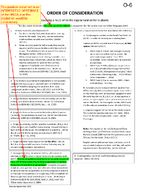
Any employee can be used in an emergency is found in the order of consideration which also references 30. 2 D. 6 of the agreement.
Which is:
"6. In emergencies, when the services of a substitute, rural
carrier associate, or rural carrier relief employee are not
available, another qualified employee may be designated by the Employer."
Rural carriers can grieve anything, whether that grievance has any merit
Is determined by the union. If the union determines that it doesn't pertain to the grievant, or has no merit, they then can withdraw the grievance.
If I was to file a grievance because after a hurricane Derrick the janitor was required to work an aux route before I was, not allowing me overtime work, my steward could withdraw it due to no overtime pay can be required/expected by carriers except in RDWL situations.
Every part of our agreement is interpretive. If a question remains about a certain subject, precedent setting grievances are then used, if none, the parties hash it out, (decide what interpretation shall be acceptable and binding). If no settlement is reached, an arbitrator is hired and paid by the looser. If no "looser" both parties pay; like when Rrecs was inflicted on us.
 
be required/expected by carriers except in RDWL situations.
Thank you for saying that. Carriers are still thinking not signing RDWL means they dont want to and dont have to work their relief day. A carrier can still be mandated because they ARE the qualifying employee.
Because of formula, some offices have every carrier on different relief days. All these carriers are doing by not signing is preventing themselves from getting all three options of pay daca 5, 3 and R will be reduced to one, only a daca 3 the one where management decides the future day off.
Unfortunately rdwl juniors can get the shaft by signing when there is a shared relief day among carriers. In my experience, the seniors refuse to sign in order to allow the junior to constantly work it.
 
Any employee can be used in an emergency is found in the order of consideration which also references 30. 2 D. 6 of the agreement.
Which is:
"6. In emergencies, when the services of a substitute, rural
carrier associate, or rural carrier relief employee are not
available, another qualified employee may be designated by the Employer."
Neither the order of consideration document nor Article 30.2.D.6 declare "any employee", but instead specifically states, "another qualified employee".

  • The Employer is limited by Article 3 (Employer Rights). Under Article 3.f (Management Rights), management has the exclusive right—subject to the Agreement and applicable laws—to take whatever actions are necessary to carry out its mission in emergencies.
  • That authority cannot be stretched beyond the Agreement itself. Article 37 (Scope of Agreement) specifically identifies that the current contract is the complete and exclusive agreement between the parties; it fully defines their rights and obligations.
  • Because the National Agreement does not apply to employees in other crafts (Article 1.2.f – Exclusion), the Employer cannot extend its terms to those employees, even during emergencies.
  • Therefore, when applying Article 30.2.D.6, the Employer may not designate an employee from another craft.
It appears your position is that (and please correct me if I've misunderstood) the individual management designates as "qualified" becomes "qualified" by nature of being selected. I.e., whatever employee management selects to perform bargaining unit work under 30.2.D.6 becomes automatically qualified because management declared it so.

If I am accurately reflecting your position, here's why I disagree.

A qualification, by definition, can never be met without satisfying its prerequisites. If management's designation of an employee were the only prerequisite, then the word "qualified" would be superfluous. The phrase, "...another qualified employee may be designated by the Employer." would be the equivalent to, "...another employee may be designated by the Employer."

Article 30.1.P is currently modified by the August 15, 2025 MOU
  • Article 30.1.P - A regular rural carrier shall not be required to serve all or part of any rural route other than his or her assigned route except as provided in ELM, Section 546 [, Reassignment or Reemployment of Employees Injured on Duty].
In that MOU, management must exhaust or waive authority of 30.2.D.6 before applying the MOU.

August 15, 2025 MOU Snippet.png

Under the theory that 30.2.D.6 permits management to utilize other craft employees to perform bargaining unit work, the MOU would grant management the right to place other bargaining unit craft employees on rural craft bargaining unit work before utilizing all members from assigned bargaining unit craft. I.e., the union would have agreed to grant non-craft precedence to craft work over the craft it represents, at management's discretion.

Rural carriers can grieve anything, whether that grievance has any merit
Is determined by the union. If the union determines that it doesn't pertain to the grievant, or has no merit, they then can withdraw the grievance.
Not if it's resolved at discussion.

If I was to file a grievance because after a hurricane Derrick the janitor was required to work an aux route before I was, not allowing me overtime work, my steward could withdraw it due to no overtime pay can be required/expected by carriers except in RDWL situations.
Under the theory that management can utilize non-craft employees at 30.2.D.6, I'd agree. If not though:
  • Management violated the MOU by utilizing an ineligible employee to perform bargaining unit work while the elegible grievant was available, interested, and willing to volunteer, had management provided the option to the elegible grievant rather than the ineligible employee.

Every part of our agreement is interpretive. If a question remains about a certain subject, precedent setting grievances are then used, if none, the parties hash it out, (decide what interpretation shall be acceptable and binding). If no settlement is reached, an arbitrator is hired and paid by the looser. If no "looser" both parties pay; like when Rrecs was inflicted on us.
Which brings me back to the original question; Are rural craft employees not permitted access to the grievance procedure in relation to complaints involving interpretation of the National Agreement?

Take this issue with 30.2.D.6, if the answer is one of these two theories (or some third theory neither of us touched on), presuming access to interpretive grievances are permitted, how would one phrase an interpretive grievance (on this or some other interpretive question) to get the answer in writing? 🤔
 
Which brings me back to the original question; Are rural craft employees not permitted access to the grievance procedure in relation to complaints involving interpretation of the National Agreement?
Are you trying to grieve the outcome of a grievance?

It seems simple, if an interpretation hasn’t been made yet on a given issue which requires interpretation, one will be made at one of the steps(1-4 or arbitration).
Once an interpretation is made, that’s basically it.
I think, as stated earlier, there may be varying interpretations regionally due to local circumstances of certain issues.
There also may be exceptions in which new interpretations can be made due to technological advances for instance.
 
Neither the order of consideration document nor Article 30.2.D.6 declare "any employee", but instead specifically states, "another qualified employee".

  • The Employer is limited by Article 3 (Employer Rights). Under Article 3.f (Management Rights), management has the exclusive right—subject to the Agreement and applicable laws—to take whatever actions are necessary to carry out its mission in emergencies.
  • That authority cannot be stretched beyond the Agreement itself. Article 37 (Scope of Agreement) specifically identifies that the current contract is the complete and exclusive agreement between the parties; it fully defines their rights and obligations.
  • Because the National Agreement does not apply to employees in other crafts (Article 1.2.f – Exclusion), the Employer cannot extend its terms to those employees, even during emergencies.
  • Therefore, when applying Article 30.2.D.6, the Employer may not designate an employee from another craft.
It appears your position is that (and please correct me if I've misunderstood) the individual management designates as "qualified" becomes "qualified" by nature of being selected. I.e., whatever employee management selects to perform bargaining unit work under 30.2.D.6 becomes automatically qualified because management declared it so.

If I am accurately reflecting your position, here's why I disagree.

A qualification, by definition, can never be met without satisfying its prerequisites. If management's designation of an employee were the only prerequisite, then the word "qualified" would be superfluous. The phrase, "...another qualified employee may be designated by the Employer." would be the equivalent to, "...another employee may be designated by the Employer."

Article 30.1.P is currently modified by the August 15, 2025 MOU
  • Article 30.1.P - A regular rural carrier shall not be required to serve all or part of any rural route other than his or her assigned route except as provided in ELM, Section 546 [, Reassignment or Reemployment of Employees Injured on Duty].
In that MOU, management must exhaust or waive authority of 30.2.D.6 before applying the MOU.

View attachment 16784

Under the theory that 30.2.D.6 permits management to utilize other craft employees to perform bargaining unit work, the MOU would grant management the right to place other bargaining unit craft employees on rural craft bargaining unit work before utilizing all members from assigned bargaining unit craft. I.e., the union would have agreed to grant non-craft precedence to craft work over the craft it represents, at management's discretion.


Not if it's resolved at discussion.


Under the theory that management can utilize non-craft employees at 30.2.D.6, I'd agree. If not though:
  • Management violated the MOU by utilizing an ineligible employee to perform bargaining unit work while the elegible grievant was available, interested, and willing to volunteer, had management provided the option to the elegible grievant rather than the ineligible employee.


Which brings me back to the original question; Are rural craft employees not permitted access to the grievance procedure in relation to complaints involving interpretation of the National Agreement?

Take this issue with 30.2.D.6, if the answer is one of these two theories (or some third theory neither of us touched on), presuming access to interpretive grievances are permitted, how would one phrase an interpretive grievance (on this or some other interpretive question) to get the answer in writing? 🤔
And many of us on here have answered your original question. No, the grievance process is not appropriate for this.
 
Neither the order of consideration document nor Article 30.2.D.6 declare "any employee", but instead specifically states, "another qualified employee".

  • The Employer is limited by Article 3 (Employer Rights). Under Article 3.f (Management Rights), management has the exclusive right—subject to the Agreement and applicable laws—to take whatever actions are necessary to carry out its mission in emergencies.
  • That authority cannot be stretched beyond the Agreement itself. Article 37 (Scope of Agreement) specifically identifies that the current contract is the complete and exclusive agreement between the parties; it fully defines their rights and obligations.
  • Because the National Agreement does not apply to employees in other crafts (Article 1.2.f – Exclusion), the Employer cannot extend its terms to those employees, even during emergencies.
  • Therefore, when applying Article 30.2.D.6, the Employer may not designate an employee from another craft.
It appears your position is that (and please correct me if I've misunderstood) the individual management designates as "qualified" becomes "qualified" by nature of being selected. I.e., whatever employee management selects to perform bargaining unit work under 30.2.D.6 becomes automatically qualified because management declared it so.

If I am accurately reflecting your position, here's why I disagree.

A qualification, by definition, can never be met without satisfying its prerequisites. If management's designation of an employee were the only prerequisite, then the word "qualified" would be superfluous. The phrase, "...another qualified employee may be designated by the Employer." would be the equivalent to, "...another employee may be designated by the Employer."

Article 30.1.P is currently modified by the August 15, 2025 MOU
  • Article 30.1.P - A regular rural carrier shall not be required to serve all or part of any rural route other than his or her assigned route except as provided in ELM, Section 546 [, Reassignment or Reemployment of Employees Injured on Duty].
In that MOU, management must exhaust or waive authority of 30.2.D.6 before applying the MOU.

View attachment 16784

Under the theory that 30.2.D.6 permits management to utilize other craft employees to perform bargaining unit work, the MOU would grant management the right to place other bargaining unit craft employees on rural craft bargaining unit work before utilizing all members from assigned bargaining unit craft. I.e., the union would have agreed to grant non-craft precedence to craft work over the craft it represents, at management's discretion.


Not if it's resolved at discussion.


Under the theory that management can utilize non-craft employees at 30.2.D.6, I'd agree. If not though:
  • Management violated the MOU by utilizing an ineligible employee to perform bargaining unit work while the elegible grievant was available, interested, and willing to volunteer, had management provided the option to the elegible grievant rather than the ineligible employee.


Which brings me back to the original question; Are rural craft employees not permitted access to the grievance procedure in relation to complaints involving interpretation of the National Agreement?

Take this issue with 30.2.D.6, if the answer is one of these two theories (or some third theory neither of us touched on), presuming access to interpretive grievances are permitted, how would one phrase an interpretive grievance (on this or some other interpretive question) to get the answer in writing? 🤔
First, qualified means that the Usps employee has been trained to drive the vehicle needed for the route, and is able to drive and do the work with no medical restrictions. That includes all those employees that have received the training needed after haveing exhausted the rural carriers willing and able to help.
Second, if a "Grievance" is resolved at the first step discussion then it isn't a grievance. It was an agreed upon discussion, that's why it's called the first step DISCUSSION. Therefore no need for a grievance.
 
Since future rural pay is reflected in performance, shouldnt we be concerned about a definition for what qualifies a person to carry a rural route. Shouldn't we be concerned that the people covering our routes are actually trained on rrecs and actually had training on the route they are being asked to carrier? Oh, wait, I forgot there is no mandated training required. 😈
You carry it, you are trained on it.
Kind of backwards but thats how we roll.
 
Are you trying to grieve the outcome of a grievance?
Not currently, but grieving an interpretive-type grievance (i.e., neither an applicative nor compliant grievance) appears possible to issues needing interpretation. The first to my mind is the meaning of "on occasion" related to the step-4 when splitting a route.

In my experience, (perhaps yours as well, but perhaps not) the colloquial meaning of "on occasion" is "sparingly". However, literally, "on occasion" could mean "discretionary execution whenever an occasion presents itself, regardless of frequency."

OOC - Union's position paper.png

It seems simple, if an interpretation hasn’t been made yet on a given issue which requires interpretation, one will be made at one of the steps(1-4 or arbitration).
Once an interpretation is made, that’s basically it.
I agree. The parties would have agreed to a foundational meaning and that issue is put to bed.

I think, as stated earlier, there may be varying interpretations regionally due to local circumstances of certain issues.
I agree. There will be local/district/area varieties. Of those varieties, local/district/area management and local/district/area union may be content with those interpretations, which shape rule application and/or determine compliance.

However, whatever that interpretation is, both sides must be able to articulate their interpretation. That's the only way to determine if there is any difference when comparing each side's position. The "order of consideration" is a helpful position paper. "Qualified" (in item 5 of the paper) for purposes of that item is specifically defined. That definition of "qualified" does not carry over to its use in item 9 though. The meaning of "qualified" in item 9 is not explicit, leaving readers to cobble meaning through implications.

I'm convinced it is limited to those specific employees which the parties included an "in emergencies" prerequisite. I believe if this were not the case, the "in emergencies" prerequisites given would be meaningless. Those without an "in emergencies" prerequisite would be just as accessible as those with an "in emergencies" prerequisite.

The only 2 employee groups I've seen in rural agreements with the "in emergencies" prerequisite are supervisory employees (Article 1.6) and leave replacements who have worked on assignments valued at 12 evaluated hours or more (NRLCA order of consideration position paper - item 7, above).

There also may be exceptions in which new interpretations can be made due to technological advances for instance.
I agree in the sense that it may create new applicative concepts, i.e., how the definition is applied to the new technology, but also that the parties may agree to jointly modify their interpretive positions. However, if those positions don't match, Article 4.3 gives the union a path to resolve it.
 
First, qualified means that the Usps employee has been trained to drive the vehicle needed for the route, and is able to drive and do the work with no medical restrictions. That includes all those employees that have received the training needed after haveing exhausted the rural carriers willing and able to help.
I understand your presented definition, and it may very well be the one both sides have agreed upon, but I've not yet seen anything that explicitly confirms that position. Just because I haven't personally seen it though doesn't mean that it doesn't exist.

Can you point to the union/postal material(s) that brought you to this conclusion? I'm not closed to being convinced of a different conclusion.

Second, if a "Grievance" is resolved at the first step discussion then it isn't a grievance. It was an agreed upon discussion, that's why it's called the first step DISCUSSION. Therefore no need for a grievance.
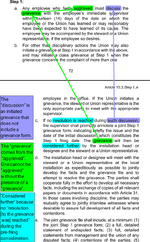
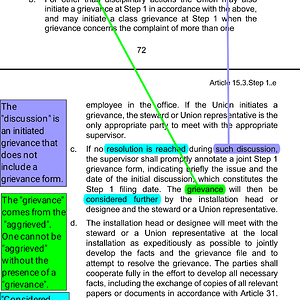
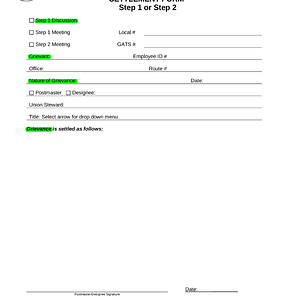
A grievance initiated (Article 15.3. Step 1 a./b.) and a grievance filed (Article 15.3. Step 1 c.) are two different items. In both cases, it is a grievance.

Discussion.png

In either case (discussed with resolution [a. or b.] or filed [c.]) the initiant is identified as the "grievant", and their difference/dispute/disagreement/complaint is identified as a "grievance".
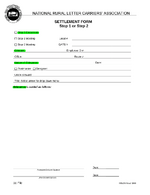
Settlement Form.png

If a grievance is resolved in whole at step 1 .a or b., I agree that there is no need to file the grievance on that issue because the issue would be resolved. "Filing" following any agreed resolution would indicate that the grievance was not settled between management and grievant in whole, but only in part.
 
Since future rural pay is reflected in performance, shouldnt we be concerned about a definition for what qualifies a person to carry a rural route.
I believe so, and it concerns me.

Shouldn't we be concerned that the people covering our routes are actually trained on rrecs and actually had training on the route they are being asked to carrier?
At best, only Rural Carriers and (some) supervisory employees have RRECS training, though I don't know what certifies a carrier/supervisor as "RRECS trained". I thought there was something out there where the union positioned that giving carriers a scanner function summary sheet was insufficient training. I'd have to search for that answer.

I hope that "RRECS trained" is a prerequisite to being part of 30.2.D.6's "qualified" class, but since it's not explicit, who knows. 🤷‍♂️

If management is presumed as "RRECS trained", and leave replacements are also presumed as "RRECS trained", then the theory that those employee groups with an emergency-use qualifier (i.e., supervisors and leave replacement carriers who will have worked 12 evaluated hours or more) would still be a functional theory.

Oh, wait, I forgot there is no mandated training required. 😈
You carry it, you are trained on it.
Kind of backwards but thats how we roll.
For 30.2.D.3's definition of "qualified", trained or utilized breaks the seal for leave replacements at that step in the "Order of Consideration" (item 5), but that qualifier is not explicit in 30.2.D.6 (Order of Consideration - item 9).
 
Back
Top