• Everyone, please help make our jobs easier and choose the correct category. Thank you

Is management-authorized meeting time with a union representative, compensable?

Get over yourself dude. I am reading and correctly interpreting the RCAM. I can tell you this, the people I represented were (and still are I'm told) extremely happy with what I did for them.
Yeah... I always see carriers line up for miles, "extremely happy" to work for free! 🤣 Just the other day, I heard a cluster of carriers threatening to quit if management kept paying them to work! :rolleyes:

You've made my holiday and renewed the joy I accumulate from putting my money into my TSP instead of the union's coffers. 🤣 And you're a self-proclamed, highly-experienced rep too? 🤦‍♂️ Bravissimo! 👏 🥳

I ❤️ it! Keep the humor coming! 🤣
 
The issue I see with Article 17.3 in application to the wording in the RCAM, is that 17.3 specifically addresses the rights of the steward in fulfilling their duties, not those of a carrier in researching policy, even if that research is in good faith, and leads to a grievance.

When it is necessary for a steward to leave the work area to investigate and adjust grievances or to investigate a specific problem to determine whether to file a grievance, the steward shall request permission from the immediate supervisor, and such request shall not be unreasonably denied.

So I don't, unfortunately, see that there's a question as to whom is being referred to when the RCAM references Article 17.3, as that Article specifically pertains to the rights of a steward. Given that stewards are given some leeway to investigate and file class action grievances, etc., it at least makes a reasonable amount of sense that they would be given more latitude in what they are compensated for and when.

And yes, while stewards accrue Z time, and carriers are paid out via 8127, they're both compensation for the terms of our contractual language. If I'm picking up what you're putting down, some of this revolves around what constitutes an Interview, and when is that compensable. I'd suspect your representatives are holding that, as Interviews are a direct component of investigating a grievance, and are therefore part of the grievance file (with their own paperwork etc) that a steward submits to the DR or ADR upon finishing the grievance or kicking it to Step 2, that there's enough of a body of interpretive language that it's not applicable to carriers requesting to speak to a steward, but the other way around (Steward speaking to carrier).

If management wants to pay, I think that's just fine and dandy. They're doing what feels like should be right. But at least, to my eyes, taking each contractual provision in totality, the union reps are technically right. If there are further articles of the contract, or § in the relevant supporting documents that give a strong argument against that interpretation, it'd change my spot interpretation on that pretty quickly; since it's what feels like should happen, but I just can't find a decent linkage to make it so. (I'm also by no means always correct, but I'd prefer being proven wrong, if it leads to a learning moment... So I can be right next time 🤣 Heck, compensating this type of time is something my office has always done, and I'd presumed that was the appropriate response until yesterday. Now I have to play the see no evil/speak no evil game)

And yes, the lake is far more interesting than most contractual deep dives. (Despite my tendency to engage in the crunchier side of things.) Y'all get some of my eyes time when I've got my bourbon by the fire, or coffee by the water. Cheers!
 
Last edited:
@NorthernPines For me, the tie to a compensable interview is management's approval to the union's request to interview an employee. Management is authorizing the work flow interruption, and the carrier is performing tasks authorized by management that is external to their daily assigned duties.

I'm not convinced the initiant (carrier requests time with steward or reciprical), is a relevant factor because regardless of initiant, management would have to permit the carrier to leave the work area or halt functions to meet. It raises the question though as to whether management violates any rule by denying a carrier's request (carrier as initiant) to meet with their steward to discuss a potential/actual grievance.

On that question, for a denial, I'd tie it to 15.1 as an intentional frustration of resolving the issue at the lowest possible step. An employee clarifying the union's position before presenting it as a dispute could resolve the dispute if the employee's understanding of the terms were way off. Conversely it could bring greater clarity to the carrier of the relevant rules and add precision and thrust to the carrier's discussion presentation, potentially increasing the likelihood of a mutual understanding and agreement, prior filing, if not resolved at discussion.

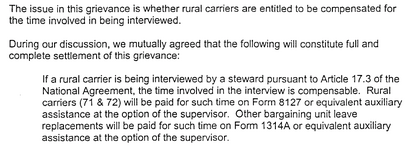
While the title (17.3) indeed focuses on steward rights, the employee payment is a byproduct of a steward exercising those rights. The RCAM citation of the step-4 is only a citation of an existing step-4 agreement (C95R-4C-C 01194393) . The publishers placed the citation under 17.3. They could have placed the citation under Article 30 or even just a page at the end of the book and it would have been the same material cited without change of words or meaning. The step-4 cited does not give a steward any new rights nor does it expand on the rights of stewards. It only addresses whether rural carriers are entitled to be compensated for the time involved in being interviewed by a steward under 17.3.

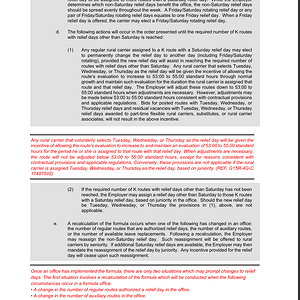
ezpdf.snapshot.391.png

There are no other articles that permit steward interviews that don't rely upon the scope of rights given to stewards in 17.3. If a carrier being the initiant modifies the compensation outcome, would that "meeting" itself fall outside the scope of 17.3 because the steward must be the initiant for meeting time? If that were the case, then management has no right to permit "meeting time" for a carrier initiant, because no mechanisim for "meeting time" would exist for the initiant carrier, and a steward would have no 17.3 right to engage a meeting.

While I disagree that there could ever be a case that a carrier having approved meeting time with a steward where that meeting time is not compensable, for the sake of argument, if I'm mistaken, how would management record non-compensable, management-approved meeting time in timekeeping?
  • They couldn't tie it to lunch because the approval prerequisite component.
  • They couldn't tie it to annual work hours because the meeting with the steward is not a carrier duty.
  • They couldn't tie it to anything not identified as "non-productive work hours" because of F-21 definitions of "meeting time"
  • They couldn't avoid a 7020 because that is how "meeting time" is recorded.
  • If they don't want to call it "meeting time" then they cross into the land of unidentified terms for "on the clock" hours - that's messy business.
If there is a way, it's hidden to me. I haven't found a timekeeping category in F-21 that would work with that theory. The time would need recorded in some fashion. Compensable "meeting time" is the only one I see that jives.

Sounds like a great weekend! Congratulations on finding some peace! 😁👍
 
Look up how this is handled in city and clerk crafts.
Why would our rural grievants not get paid for this process when city and clerk grievants do?
We get paid the evaluation.
Time to discuss working rules does not have a time standard associated with the evaluation.
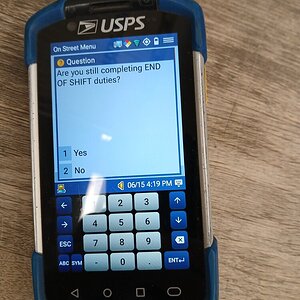
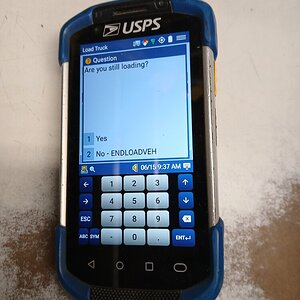
Could this type of discussion be included in EOS OR Load? The grievant is an individual not associated with route volume, so keeping the issues separate is a matter of proper volume collection for the route.
No rural I work with understands how to say "can I have 8127 time to discuss this matter with my steward?"
Everyone I work with calls the steward on lunch or after they get off work. Let's say the steward calls you back when you are on the route
(This has happened to me) How can I ask permission to get 8127 time while on street delivering? So, I clocked out to lunch....shorting my lunch break to discuss the matter at hand🙄
 
Back
Top