Step 4 – RCAs working over 12 hours

As many will say, the union is still living in the past and not adjusting things to help better the career of their employees. Constantly taking pay cuts and etc.

Here is my question, why can't we hire and keep people and what has the union DONE TO ADDRESS THIS?!?!?!? NOT MUCH and neither had USPS.
The union could defend the inherent rights of the probationary period, i.e., management's obligation to actively guide probationary employees towards a successful performance.

The probationary period isn't intended for in-office gossiping on how "bad" a new employee is, nor is it a hands-free opportunity for management to exercise some half-baked "trial by fire" employment methodology.

EL-312, Employment and Placement

584.1 Significance of Probationary Period
The probationary period represents the final step in determining an employee’s suitability, since only an actual trial on the job can be conclusive.
Proper use of the probationary period is in the best interests of both the new employee and the Postal Service. During this period, the new employee receives orientation and whatever training the employee needs.
Attentiveness to the new employee, both in training sessions and on the job, may ensure the satisfaction and efficiency of an employee who might otherwise be separated.

584.2 Outlining Expectations
At the time the oath of office is administered, or during the new employee orientation session, new hires should become familiar with the probationary period and its purpose. The supervisor is responsible for constant informal evaluation throughout the probationary period. This involves close observation and analysis of the new employee’s performance to determine both proficiencies and deficiencies. The supervisor consistently attempts by guidance, counsel, and training to assist the new employee to correct any deficiencies in either conduct or performance.


Unfortunately, the union opposes its own representatives filing grievances when management fails in this regard, and the new employee is too green to know what they can actively rely upon from most management. Some (I'd bet many) managers don't know how to train the new employees, and/or don’t have time to do so between the report of a report of a report's report they need to report, or answering calls from angry customers or superiors.

The result is EL-312 §584.1's forecasted, "otherwise be separated". 🤷‍♂️

There's also the weak paycheck issue. Apparently people like a steady income to pay their steady bills.

Imagine that! 🤔
 
We've all read about offices that are so shorthanded that routes just don't get delivered daily. Or offices where only the Amazon is delivered on a consistent basis. Fact is there are offices that just can't get everything delivered everyday. Should people get their bills, checks, medications, etc. every day, absolutely. But if they don't it's not an emergency, it's an inconvenience.
An emergency is flood, fire, hurricane, zombie apocalypse, blizzard, etc.
 
The thing is that for RCA's there is nothing designated in the labor agreement for working over 12 hours as there is for regular carriers. Absent anything in the agreement, the ELM language is the rule which outside of an emergency (determined by the PMG) they can't be "required" to work more than 12 hours.
 
The thing is that for RCA's there is nothing designated in the labor agreement for working over 12 hours as there is for regular carriers. Absent anything in the agreement, the ELM language is the rule which outside of an emergency (determined by the PMG) they can't be "required" to work more than 12 hours.
Step-4's and arbitrations are extensions of the labor agreement, granted authority through the labor agreement, and applicable to entities bound by the labor agreement.

If this weren't the case, the ELM would prevail over the contract in all cases, and the step-4 referenced in the origin of this thread would be meaningless.

The "requirement" comes from ELM 665.15, Article 3.f, and an unsatisfied prerequisite of Article 30.2.D.6.
 
We've all read about offices that are so shorthanded that routes just don't get delivered daily.
This condition doesn’t negate management's obligation to the postal services mission under Article 3, nor their avenue to ensure accomplishment of that mission via exercise of 3.f.

Or offices where only the Amazon is delivered on a consistent basis.
Again, this condition doesn't negate management's obligation to the postal services mission under Article 3, nor their avenue to ensure accomplishment of that mission via exercise of 3.f.

Fact is there are offices that just can't get everything delivered everyday.
Again, this condition doesn't negate management's obligation to the postal services mission under Article 3, nor their avenue to ensure accomplishment of that mission via exercise of 3.f.

Additionally, cutoff times can play a factor when determining whether mail has been delayed, or when that delivery must be attempted. There's also the color code policy on BBM.

Should people get their bills, checks, medications, etc. every day, absolutely. But if they don't it's not an emergency, it's an inconvenience.
What you've described is an example of a result of not tending to an emergency, not the emergency itself.

An emergency is flood, fire, hurricane, zombie apocalypse, blizzard, etc.
I disagree, but for the sake of argument, let's presume you're correct.

Does this mean to you that, under the MOU, regulars can only assist other rural routes when there is a "is flood, fire, hurricane, zombie apocalypse, blizzard", and never because of a lack of manpower?
 
Step-4's and arbitrations are extensions of the labor agreement, granted authority through the labor agreement, and applicable to entities bound by the labor agreement.

If this weren't the case, the ELM would prevail over the contract in all cases, and the step-4 referenced in the origin of this thread would be meaningless.

The "requirement" comes from ELM 665.15, Article 3.f, and a unsatisfied prerequisite of Article 30.2.D.6.
There are no step 4s or arbitrations anywhere that requires a RCA to work more than 12 hours. All of the things you mentioned are prohibitions against requiring not any one grants actual permission to require. This falls to the second aspect of “emergency “ and in this case the emergency has to be dictated by the PMG. You are making a mountain out of a molehill on this. The step 4 codifies the ELM language plain and simple.
 
There are no step 4s or arbitrations anywhere that requires a RCA to work more than 12 hours.
So in emergency situations, when management schedules a leave replacement to serve on two full assignments or one full assignment and one or more partial assignments in a single day, and the evaluations of these assignments total twelve hours or more, you expect them to complete it all in under 12 hours? 🤔

All of the things you mentioned are prohibitions against requiring not any one grants actual permission to require.
So your position is that even in an emergency situations, leave replacements are restricted from working over 12?

Neither ELM 665.15, Article 3.f, nor 30.2.D.6 do any of the things you've claimed them to do. Your conclusion makes no sense.

This falls to the second aspect of “emergency “ and in this case the emergency has to be dictated by the PMG. You are making a mountain out of a molehill on this. The step 4 codifies the ELM language plain and simple.
It seems that you're just arguing an echo chamber in circles.
 
So in emergency situations, when management schedules a leave replacement to serve on two full assignments or one full assignment and one or more partial assignments in a single day, and the evaluations of these assignments total twelve hours or more, you expect them to complete it all in under 12 hours? 🤔


So your position is that even in an emergency situations, leave replacements are restricted from working over 12?

Neither ELM 665.15, Article 3.f, nor 30.2.D.6 do any of the things you've claimed them to do. Your conclusion makes no sense.


It seems that you're just arguing an echo chamber in circles.
NO, what I am saying is that this Step 4 and the ELM CLEARLY state that RCA's can not be "required" to work more than 12 hours unless there is an emergency as dictated by the PMG! The scheduling is entirely different, the language states they can't be "scheduled" for more than 12 hours based on the evaluations of the assignments they are being "scheduled" for. It doesn't matter if they are capable of completing them in 8 hours, it should not be done. These are two entirely different issues and trying to tie them together is like comparing apples and oranges. And of course, nothing I say makes any sense to you, never seems to on any subject. I'm not the one arguing in circles.
 
NO, what I am saying is that this Step 4 and the ELM CLEARLY state that RCA's can not be "required" to work more than 12 hours unless there is an emergency as dictated by the PMG!
It seems your preference is the second triggering condition. You need to take a look at the first.

Except as designated in labor agreements for bargaining unit employees
or
in emergency situations as determined by the postmaster general (or designee),

employees may not be required to work more than 12 hours in 1 service day. In addition, the total hours of daily service, including scheduled workhours, overtime, and mealtime, may not be extended over a period longer than 12 consecutive hours. Postmasters and exempt employees are excluded from these provisions.

The reason why the second triggering mechanism exists is because not every postal employee is under a CBA! It's irrelevant to employees with a CBA because it would grant the PMG an override to whatever was negotiated for emergency provisions and subject to the first triggering mechanism. The second triggering mechanism gives a bridge to the company for applying emergency provisions to employees not under a CBA.

The scheduling is entirely different, the language states they can't be "scheduled" for more than 12 hours based on the evaluations of the assignments they are being "scheduled" for. It doesn't matter if they are capable of completing them in 8 hours, it should not be done.

Excluding emergency situations, I agree with you.

Help make sense of a step-4 that allows management to schedule an employee, specifically in emergencies, for more than 12 evaluated hours yet simultaneously has no obligation to perform beyond 12 hours.

R-96 specifically includes 2 full assignments as a separate item than 1 full assignment and any amount of partial assignments. How on Earth is that even realistic? Why would an "emergency situation" even need to exist to schedule an employee for over 12 evaluated hours if management can already use an RCA to take portions of a route when no emergency exists?

Do you believe the "scheduled" leave replacement is permitted to curtail all undelivered mail that didn't meet its destination under the 12-hour threshold during the emergency which specifically called for adjustments to the leave replacements "schedule"?

These are two entirely different issues and trying to tie them together is like comparing apples and oranges.
Apples and oranges are easily comparable; they are both fruits.

And of course, nothing I say makes any sense to you, never seems to on any subject.
There's bound to be some things we agree on, though I'm not going to dig through threads to find out.

I'm not the one arguing in circles.
Really? 🤔
 
It seems your preference is the second triggering condition. You need to take a look at the first.

Except as designated in labor agreements for bargaining unit employees
or
in emergency situations as determined by the postmaster general (or designee),

employees may not be required to work more than 12 hours in 1 service day. In addition, the total hours of daily service, including scheduled workhours, overtime, and mealtime, may not be extended over a period longer than 12 consecutive hours. Postmasters and exempt employees are excluded from these provisions.

The reason why the second triggering mechanism exists is because not every postal employee is under a CBA! It's irrelevant to employees with a CBA because it would grant the PMG an override to whatever was negotiated for emergency provisions and subject to the first triggering mechanism. The second triggering mechanism gives a bridge to the company for applying emergency provisions to employees not under a CBA.


Excluding emergency situations, I agree with you.

Help make sense of a step-4 that allows management to schedule an employee, specifically in emergencies, for more than 12 evaluated hours yet simultaneously has no obligation to perform beyond 12 hours.

R-96 specifically includes 2 full assignments as a separate item than 1 full assignment and any amount of partial assignments. How on Earth is that even realistic? Why would an "emergency situation" even need to exist to schedule an employee for over 12 evaluated hours if management can already use an RCA to take portions of a route when no emergency exists?

Do you believe the "scheduled" leave replacement is permitted to curtail all undelivered mail that didn't meet its destination under the 12-hour threshold during the emergency which specifically called for adjustments to the leave replacements "schedule"?


Apples and oranges are easily comparable; they are both fruits.


There's bound to be some things we agree on, though I'm not going to dig through threads to find out.


Really? 🤔
Let's just agree to disagree. Work hours and scheduling hours are two completely different items that in the context of this discussion have absolutely nothing to do with each other. Like I said before, this is all very clear until you try and muddy up the water! I give up.
 
Let's just agree to disagree. Work hours and scheduling hours are two completely different items that in the context of this discussion have absolutely nothing to do with each other. Like I said before, this is all very clear until you try and muddy up the water! I give up.

I get your position, and I don't entirely disagree with it. I don't expect you to reply nor am I holding my breath about it, but I'm posting a response anyway.

I'm convinced your approach to the step 4 is.
  1. Art 3 allows management to execute emergency procedures, but no emergency procedure executed may conflict with the National Agreement.
  2. The ELM cannot bridge a gap that would allow a leave replacement to have over 12 working hours, even in an emergency.
    1. No less than the recent step 4 is controlling in emergency situations.
  3. While management may direct employees under ELM 665.15, any direction or result of any direction involving any leave replacement working over 12 hours in a day is a violation.
    1. A violation would include a leave replacement working over 12 actual hours in a day, regardless of how many routes or evaluated hours they're assigned to perform.
    2. The number of routes or evaluated hours assigned to a leave replacement does not constitute a promised performance, as 12 actual hours is the most workhours a leave replacement may be required to perform in a day, regardless of scheduled routes or hours, because of no less than the recent step 4.
I think I've articulated your position accurately (maybe not), and I don't think it's a "bad" position. If R-96 didn't exist, I'd be on-board.

R-96 permits splitting routes regardless of the presence or absence of an emergency.
  • If a "normal situation" permits management to schedule a leave replacement to work more than one route for the day (be it a full and partial or an array of partial assignments) with an evaluated time totalling less than 12 hours, then...
  • What is the point of management being able to schedule a leave replacement in an "emergency situation" to work more than one route for the day (be it a full and partial or an array of partial assignments) with an evaluated time totalling 12 or more hours, if the leave replacement employee cannot cross the 12-hour mark in the first place, even during an emergency?
It seems superfluous for management to gain a right to schedule an employee for over 12 evaluated hours knowing full well that the employee has no obligation to actually perform for 12 hours. Without that obligation, what special instruction ability does management functionally gain by being in an "emergency situation"?
  1. If they can't work over 12 in an emergency, the evaluation or number of routes scheduled is meaningless; 12 hours of labor is all they get, regardless of circumstances.
  2. If they can work over 12 in an emergency, then the step 4 is only controlling in non-emergency situations.
On the thought that they can work over 12 in emergencies, I've seen a step 4 denial from September 29, 1977, which recognized an emergency situation as a high volume of unscheduled leave. That "emergency" resulted in management rescinding approved annual leave. If a surprise element resulting in the absence of available employees can create an "emergency", then there are existing conditions (though not every condition) in which unavailable staffing can manifest an emergency situation. A surprise element may be necessary, but then, what should management be able to reasonably forecast? Should management be able to rely upon staffing from other offices, or even the reliance agreement of the RDWL? And, if so, would that unsatisfied reliance open the emergency hatch?

The issue doesn't have to matter to you, and you can "give up" or whatever, but I'm seeing an output that doesn't compute. I appreciate your viewpoints, but I'm not going to try to pry it out of you. Keep it to yourself, or not. 🤷‍♂️
 
We should go to work at 8 and be home by 5, period.

With Rrecs data and adjustments, Craft routes accordingly and build up the workforce. We have two regular routes and two aux routes. The RCA is doing both aux routes and is not a regular. Also, the RCA has no time to help the regulars. We can't hire anyone, if management is even posting at all?

It's as if the whole thing is setup for abuse, greed, and profit at the expense of the workforce.
 
I get your position, and I don't entirely disagree with it. I don't expect you to reply nor am I holding my breath about it, but I'm posting a response anyway.

I'm convinced your approach to the step 4 is.
  1. Art 3 allows management to execute emergency procedures, but no emergency procedure executed may conflict with the National Agreement.
  2. The ELM cannot bridge a gap that would allow a leave replacement to have over 12 working hours, even in an emergency.
    1. No less than the recent step 4 is controlling in emergency situations.
  3. While management may direct employees under ELM 665.15, any direction or result of any direction involving any leave replacement working over 12 hours in a day is a violation.
    1. A violation would include a leave replacement working over 12 actual hours in a day, regardless of how many routes or evaluated hours they're assigned to perform.
    2. The number of routes or evaluated hours assigned to a leave replacement does not constitute a promised performance, as 12 actual hours is the most workhours a leave replacement may be required to perform in a day, regardless of scheduled routes or hours, because of no less than the recent step 4.
I think I've articulated your position accurately (maybe not), and I don't think it's a "bad" position. If R-96 didn't exist, I'd be on-board.

R-96 permits splitting routes regardless of the presence or absence of an emergency.
  • If a "normal situation" permits management to schedule a leave replacement to work more than one route for the day (be it a full and partial or an array of partial assignments) with an evaluated time totalling less than 12 hours, then...
  • What is the point of management being able to schedule a leave replacement in an "emergency situation" to work more than one route for the day (be it a full and partial or an array of partial assignments) with an evaluated time totalling 12 or more hours, if the leave replacement employee cannot cross the 12-hour mark in the first place, even during an emergency?
It seems superfluous for management to gain a right to schedule an employee for over 12 evaluated hours knowing full well that the employee has no obligation to actually perform for 12 hours. Without that obligation, what special instruction ability does management functionally gain by being in an "emergency situation"?
  1. If they can't work over 12 in an emergency, the evaluation or number of routes scheduled is meaningless; 12 hours of labor is all they get, regardless of circumstances.
  2. If they can work over 12 in an emergency, then the step 4 is only controlling in non-emergency situations.
On the thought that they can work over 12 in emergencies, I've seen a step 4 denial from September 29, 1977, which recognized an emergency situation as a high volume of unscheduled leave. That "emergency" resulted in management rescinding approved annual leave. If a surprise element resulting in the absence of available employees can create an "emergency", then there are existing conditions (though not every condition) in which unavailable staffing can manifest an emergency situation. A surprise element may be necessary, but then, what should management be able to reasonably forecast? Should management be able to rely upon staffing from other offices, or even the reliance agreement of the RDWL? And, if so, would that unsatisfied reliance open the emergency hatch?

The issue doesn't have to matter to you, and you can "give up" or whatever, but I'm seeing an output that doesn't compute. I appreciate your viewpoints, but I'm not going to try to pry it out of you. Keep it to yourself, or not. 🤷‍♂️
#1 I would like to see the step 4 from1977, never seen that and not 100% but think that there may be contractual changes since that time. In the end I just want to say this. I did many trainings over the years and one thing I always said was "stop chasing rabbits!". A contract has MANY issues that are contradictory and left to interpretation. Don't focus on those points, there are ALWAYS arguments to be made on both side. In this case, the reason a step 4 was needed was because management refused to follow the ELM provision probably because they were saying that RCA's were covered under a labor agreement. The actual fact is that only regular carriers are covered in this situation not RCA's. It took a step 4 to codify the ELM language. This may seem stupid on the surface but it resolved a problem. Your interpretation of the scheduling issue being a part of this in my view is completely off base and "chasing rabbits".
 
On January 31, 1977, we met with you to discuss the above captioned grievance at the fourth step of our contractual grievance procedure.

The matters presented by you as well as the applicable contractual provisions have been reviewed and given careful consideration.

Due to the number of unscheduled absences, an emergency situation arose requiring the presence of the grievant to serve his route. In view of these circumstances, the grievant's request for annual leave was disapproved. We find no justification for reimbursing the grievant for any cost incurred in making annual leave plans. Therefore, the grievance is denied.


I just sent an image of it to you in DM.
 
On January 31, 1977, we met with you to discuss the above captioned grievance at the fourth step of our contractual grievance procedure.

The matters presented by you as well as the applicable contractual provisions have been reviewed and given careful consideration.

Due to the number of unscheduled absences, an emergency situation arose requiring the presence of the grievant to serve his route. In view of these circumstances, the grievant's request for annual leave was disapproved. We find no justification for reimbursing the grievant for any cost incurred in making annual leave plans. Therefore, the grievance is denied.


I just sent an image of it to you in DM.
This is one I had never seen (it actually predates me lol). I do wish I knew the actual grievance and violation this is pertaining too, you may know what it is. The reason I say that is because in reading the decision it refers to the "grievant's request for leave was disapproved" not that approved annual leave was canceled. To me that is a very big difference, and it may be that it was for that reason but it doesn't read that way to me.
 
This is one I had never seen (it actually predates me lol). I do wish I knew the actual grievance and violation this is pertaining too, you may know what it is. The reason I say that is because in reading the decision it refers to the "grievant's request for leave was disapproved" not that approved annual leave was canceled. To me that is a very big difference, and it may be that it was for that reason but it doesn't read that way to me.

The national agreement of that time (1975-1978 CBA) had the following language:

Article X, section 3
Vacation Planning. The following general rules shall be observed in implementing tbe vacation planning program:

A. The Employer shall, no later than November 1, publicize on bulletin boards and by other appropriate means the beginning date of the new leave year, which shall begin with the first day of the first full pay period of the calendar year.

B. The installation head shall meet with the representatives of the Unions to review local service needs as soon after January 1 as practical. He shall then:

  1. Determine the amount of annual leave accrued to each employee's credit including that for the current year and the amount he expects to take in the current year.
  2. Determine a final date for submission of applications for vacation period (s) of the employee's choice during the choice vacation period (s).
  3. Provide official notice to each employee of the vacation schedule approved for him.
C. A procedure in each office for submission of applications for annual leave for periods other than the choice period may be established pursuant to the implementation procedure above.

D. All advance commitments for granting annual leave must be honored except in serious emergency situations.

E. Rural carriers shall be granted annual leave in minimum units of one day in accordance with their personal wishes, provided a substitute rural carrier of record is available for their replacement. It shall be the responsibility of each rural carrier to plan his vacation at times when a substitute of record is available.


For reference, the 1977 Step 4 denial rationale:
Due to the number of unscheduled absences, an emergency situation arose requiring the presence of the grievant to serve his route. In view of these circumstances, the grievant's request for annual leave was disapproved. We find no justification for reimbursing the grievant for any cost incurred in making annual leave plans. Therefore, the grievance is denied.

  1. The denial rationale was that:
    1. The "number of unscheduled absences" (A) caused the "emergency situation" (B)
    2. The "emergency situation" (B) caused the "required presence of the grievant to serve his route" (C)
    3. "In view of [those] circumstances" (A→B→C), "the grievant's request for annual leave was disapproved." (D)
    4. For simplicity: (A→B→C)→D
  2. A regular carrier is required to report to work on their regularly scheduled work days.
    1. The presence or absence of an emergency situation doesn't negate the grievant's obligation to report on their regularly scheduled work days.
    2. The obligation to report on regularly scheduled work days wasn't the driving force behind the disapproved leave.
  3. The absence of a subtitute rural carrier of record was the only grounds for denying an annual leave request at the time the request was made.
    1. Once the leave was approved, the only grounds for denying that annual leave request would be a "serious emergency situation".
      1. If the annual leave is not approved at the time the request was made, the presence of a "serious emergency situation" is irrelvant to disapprove the annual leave. The annal leave was never approved, thus cannot later be disapproved on these grounds because there is nothing "approved" to "disapprove" due to a "serious emergency situation".
      2. Had no "subsitute rural carrier of record" been unavailable at the time the request was made, that would have been the driving force behind the annual leave denial, not the emergency situation.
      3. Emergency situations are relevant to disapproving annual leave requests that were previously approved at the time the request was made. The grievance denial rationale specifcally referenced an emergency situation as a driving force for the decision.
    2. If it were the case that the substitute rural carrier of record wasn't available when the request for annual leave was made, the leave request would have been denied in the local office on those grounds at the time it was made, the emergency situation would have no relevance to the denial rationale, and the rationale would have indicated that the sub of record was unavailable when the request was made, or something to that effect.
I don't believe the union would advance a grievance to step 4 with the conditions:
  1. A leave request was denied at the time it was made because no substitute rural carrier of record was available.
  2. The regular carrier incurred costs of annual leave plans without approved leave, and the grievant and union expect reimbursement for those plans, despite never having posessed approved leave.

As to whether the approval was rescinded, "rescinded" is a poor word choice on my part. It would have been better written to recognize that management has two tier approval/disapproval mechanisim for annual leave. The disaproval on the second tier results in a reversal of the approval given in the first tier, which equates to a concept of "rescinding' the approval.
  1. The first tier of the mechanisim exists at the time the annual leave request is made.
    1. The necessary condition to disapprove annual leave in the first tieris the absence of a substitute carrier of record, else the leave request is approved.
      1. A serious emergency situation isn't relevant here.
    2. The necessary condition to disapprove annual leave in the second tier is the presence of an approved leave request from the first tier, and the presence of a serious emergency situation.
      1. Though a 'serious emergency situation' could cause the absence of a substitute carrier of record, the absence of a substitute carrier of record isn't relevant here; only "a serious emergency situation".

I don't have the grievance file available at this time, but these are my thoughts on it. 🤷‍♂️
 
Did they forget the exception to the 12-hour rule? 🤔

(See R-96 in the steward reference guide)

Last I knew, the ELM was the default rule unless otherwise agreed by the parties, such as by a step-4 or arbitration. 🤷‍♂️

On several occasions, the most recent being March 22, 2002, we met to discuss the above-captioned grievance at the fourth step of our contractual grievance procedure.

The issue in this grievance is whether management violated the National Agreement when an rural carrier associate (RCA)· was scheduled to serve a regular route and an auxiliary route in a single day rather than work a regular rural carrier in accordance with Article 8 Section 5.

During our discussion, we mutually agreed that the following will constitute full and complete settlement of this grievance:

Signing of the relief day work list does not provide an entitlement to the r gular rural carrier to work the relief day due to the unavailability of a leave replacement. Management must follow the provisions outlined in Article 30 to provide coverage for a route, and may also on some occasions split a route or schedule an RCA to serve a regular route and an auxiliary route, prior to utlizlng a regular carrier to work on the relief day.

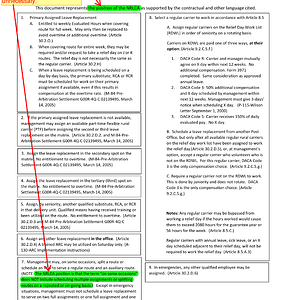
However, except In emergency situations, management must not schedule a leave replacement to serve on two full assignments or one full assignment and one or more partial assignments in a single day, if the evaluations of these assignments total twelve hours or more.
It's always an emergency
 
It's always an emergency

It's always an emergency because NO ONE DEFINES IT! This vague !$$ language allows USPS to get away with just about anything they want.

Ever look at order of consideration, they put wording regular or on-going basis. I called union on it because I worked 4 straight Saturdays with aux and part of another route thinking that would get me out of it. Union was like we don't know what regular or on-going basis means. I was like I worked 4 straight Saturdays like this and that isn't on-going or regular. Step 4 grievance. Again I ended up working 13 straight Saturdays like this before I leave this BS cause of this stupid :poop: :poop: :poop: .

Putting vague language gives all the power to USPS to get away with murder.
 
The national agreement of that time (1975-1978 CBA) had the following language:

Article X, section 3
Vacation Planning. The following general rules shall be observed in implementing tbe vacation planning program:

A. The Employer shall, no later than November 1, publicize on bulletin boards and by other appropriate means the beginning date of the new leave year, which shall begin with the first day of the first full pay period of the calendar year.

B. The installation head shall meet with the representatives of the Unions to review local service needs as soon after January 1 as practical. He shall then:

  1. Determine the amount of annual leave accrued to each employee's credit including that for the current year and the amount he expects to take in the current year.
  2. Determine a final date for submission of applications for vacation period (s) of the employee's choice during the choice vacation period (s).
  3. Provide official notice to each employee of the vacation schedule approved for him.
C. A procedure in each office for submission of applications for annual leave for periods other than the choice period may be established pursuant to the implementation procedure above.

D. All advance commitments for granting annual leave must be honored except in serious emergency situations.

E. Rural carriers shall be granted annual leave in minimum units of one day in accordance with their personal wishes, provided a substitute rural carrier of record is available for their replacement. It shall be the responsibility of each rural carrier to plan his vacation at times when a substitute of record is available.


For reference, the 1977 Step 4 denial rationale:
Due to the number of unscheduled absences, an emergency situation arose requiring the presence of the grievant to serve his route. In view of these circumstances, the grievant's request for annual leave was disapproved. We find no justification for reimbursing the grievant for any cost incurred in making annual leave plans. Therefore, the grievance is denied.

  1. The denial rationale was that:
    1. The "number of unscheduled absences" (A) caused the "emergency situation" (B)
    2. The "emergency situation" (B) caused the "required presence of the grievant to serve his route" (C)
    3. "In view of [those] circumstances" (A→B→C), "the grievant's request for annual leave was disapproved." (D)
    4. For simplicity: (A→B→C)→D
  2. A regular carrier is required to report to work on their regularly scheduled work days.
    1. The presence or absence of an emergency situation doesn't negate the grievant's obligation to report on their regularly scheduled work days.
    2. The obligation to report on regularly scheduled work days wasn't the driving force behind the disapproved leave.
  3. The absence of a subtitute rural carrier of record was the only grounds for denying an annual leave request at the time the request was made.
    1. Once the leave was approved, the only grounds for denying that annual leave request would be a "serious emergency situation".
      1. If the annual leave is not approved at the time the request was made, the presence of a "serious emergency situation" is irrelvant to disapprove the annual leave. The annal leave was never approved, thus cannot later be disapproved on these grounds because there is nothing "approved" to "disapprove" due to a "serious emergency situation".
      2. Had no "subsitute rural carrier of record" been unavailable at the time the request was made, that would have been the driving force behind the annual leave denial, not the emergency situation.
      3. Emergency situations are relevant to disapproving annual leave requests that were previously approved at the time the request was made. The grievance denial rationale specifcally referenced an emergency situation as a driving force for the decision.
    2. If it were the case that the substitute rural carrier of record wasn't available when the request for annual leave was made, the leave request would have been denied in the local office on those grounds at the time it was made, the emergency situation would have no relevance to the denial rationale, and the rationale would have indicated that the sub of record was unavailable when the request was made, or something to that effect.
I don't believe the union would advance a grievance to step 4 with the conditions:
  1. A leave request was denied at the time it was made because no substitute rural carrier of record was available.
  2. The regular carrier incurred costs of annual leave plans without approved leave, and the grievant and union expect reimbursement for those plans, despite never having posessed approved leave.

As to whether the approval was rescinded, "rescinded" is a poor word choice on my part. It would have been better written to recognize that management has two tier approval/disapproval mechanisim for annual leave. The disaproval on the second tier results in a reversal of the approval given in the first tier, which equates to a concept of "rescinding' the approval.
  1. The first tier of the mechanisim exists at the time the annual leave request is made.
    1. The necessary condition to disapprove annual leave in the first tieris the absence of a substitute carrier of record, else the leave request is approved.
      1. A serious emergency situation isn't relevant here.
    2. The necessary condition to disapprove annual leave in the second tier is the presence of an approved leave request from the first tier, and the presence of a serious emergency situation.
      1. Though a 'serious emergency situation' could cause the absence of a substitute carrier of record, the absence of a substitute carrier of record isn't relevant here; only "a serious emergency situation".

I don't have the grievance file available at this time, but these are my thoughts on it. 🤷‍♂️
I think your thoughts on this could very well be correct. Would still like to see the actual reason for grievance just to clear my doubts. Back then things were VERY different when it came to using leave. Many times management wasn't even involved/knowledgable about when a carrier was taking leave. As long as the substitute showed up everyone was happy. Many very seldom if ever even filled out a leave request. Doesn't make it right, but was the actuality in many cases. I would be pretty sure that since that step 4 was back when we were under a CBA and not the current "stand alone" contract it wouldn't be citable today anyhow. But it is good historical information none the less.
 
Back
Top