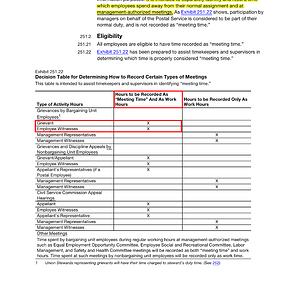
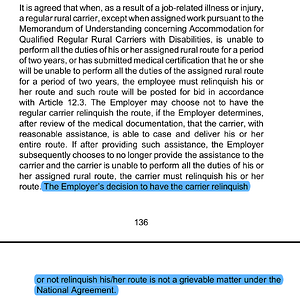
Like you posted above, #f, "All other bargaining unit craft employees.", does not apply to the NRLCA contract. Which means the NRLCA contract does not adhere or abide to any other craft employee outside the NRLCA. Therefore the city contract (NLCA) would allow them to work outside of their respective craft. In all practicality a CCA by their contract at the direction of management would allow a CCA to assist with covering a rural route. But, for that to happen management has to show that it exhausted all available resources including all in office RCAs/PTFs, outside office within 50 miles RCAs, and management themselves to cover a route. Does that happen in said order? Usually not. Management will typically assign a CCA to cover a rural route before they carry a route but they will carry a route if need be. It would be the city steward to file a grievance if their contract is violated by sending a CCA to cover a rural route unless I (as a rural steward) can show that all other avenues were exhausted before the assignment of a CCA. Several conversations with our local city steward and his grievance(s) are filed when a regular city carrier is denied leave (annual, K-day, etc.) and mandated to work to have a CCA cover a rural route.
I disagree.
The 1975-1978 Agreement was the last time other crafts were permitted to cross rural lines and perform rural craft bargaining unit work.
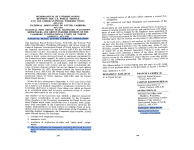
It was one of the NRLCA's main contentions for separating from the rest of the postal union's and bargaining independently from them in the subsequent 1978-1981 NRLCA National Agreement.
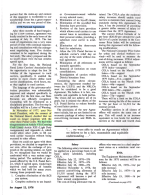
The NALC wanted to retain its remaining grip on crossing into other crafts, so it negotiated a memo so it wouldn't lose the ground it did in 1978...
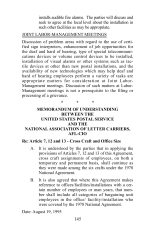
... because the NALC's 1978 agreement did not include the NRLCA.
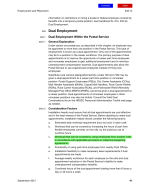
 Dual appointments
 were the exception to the rule. When a dual appointment employee is in their
casual capacity (as opposed to their
craft capacity) it's not considered "crossing crafts". They transform into a lower-paid, generic employee with a pulse.
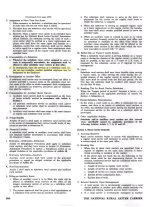
As still part of today's NRLCA Article 30.2.D.6, the 1978-1981 NRLCA National Agreement permitted
qualified employees to perform bargaining unit work once management exhausted their supply of bargaining unit employees.
Then (and now), the only
qualified employees were
management employees (under Article 1.6) and employees with a
dual appointment. Between the two, the Employer retained/retains discretionary authority as to which to assign the remaining rural craft bargaining unit work.
If memory serves me well, "dual appointments" were axed around the turn of the last decade, leaving
management as the remaining employees in the pool of
qualified employees that can be utilized in Article 30.2.D.6 situations.
Therefore the city contract (NLCA) would allow them to work outside of their respective craft. In all practicality a CCA by their contract at the direction of management would allow a CCA to assist with covering a rural route. But, for that to happen management has to show that it exhausted all available resources including all in office RCAs/PTFs, outside office within 50 miles RCAs, and management themselves to cover a route.
I don't see how this condition applies. Would you please further explain?
The generically termed "50-mile rule" is a reference to
Handbook F-15, Travel and Relocation, section 7-1.1.1. It does not preclude management from going
beyond 50 miles into the realm of "regular travel" (see also section 7-1.1.2). In fact, I understand some city craft employees have been under regular travel in some of the larger cities and are placed in hotel rooms for a period just to deliver backed-up piles of mail. Given the cost, I can't see it happening on the rural side any time soon.