they may be highly intelligent engineers BUT they have never delivered mailThis was designed by highly intelligent engineers. It's likely USPS didn't understand it. I am just a mail carrier with above average intelligence, I cannot understand and even decipher this. Frankly, I don't believe we weren't supposed to.

You are using an out of date browser. It may not display this or other websites correctly.
You should upgrade or use an alternative browser.
You should upgrade or use an alternative browser.
More packages than any Christmas day last year
- Thread starter ATCBigE
- Start date
we have been told that and it does make sense, yet WE shouldnt have to suffer the consequences of the overtime they are getting and throwing onto us all in one dayIts plant workers wanting more pay. They get higher pay for working Sundays so they clear out everything while working extra overtime and shift/weekend/night differential pay. Everyone else suffers as a results. I get about 3.5 days worth of parcels and mail on mondays now. A few years ago the leveling was decent. One route last monday has 291 parcels and tuesday it had 41.
Neither has mgtthey may be highly intelligent engineers BUT they have never delivered mail
 !
!Some have, our office actually has good mgmt that helps during peak season...I was saying that those engineers I know are highly skilled yet they have no clue when it comes to delivering mail. Alot of these RRECS data, scans, and all should have been done created and thought of times by carriers THAT HAVE PERFORMED THE JOB AND HAVE EXPERIENCE in the field.Neither has mgt
we have seen the same thing and no we do not think our mgmt and PM is changing them either...all of this is scary stuff when it is our pay!Right. Do so!!! EVERY......SINGLE......MONTH...........some of my plots have been changed. EVERY......SINGLE......MONTH........one of my dismounts distance is blank (I have 23). How much am I actually losing when this happens? I have no idea! (and fwiw, I absolutely do NOT believe my PM is going in and changing these figures).
we have been told that and it does make sense, yet WE shouldnt have to suffer the consequences of the overtime they are getting and throwing onto us all in one day
Destroying our coverage factor. I mean RRECS is freaking genius that my pay is affected by them.

I am sure these all came on a Monday...? There is absolutely no reason why these couldnt go out sparingly thru the week to even the mail volume so to speak-yet I am sure your office is like mine and all must go the day we receive it..I agree totally this is just not right.Hey I FOUND THEM!
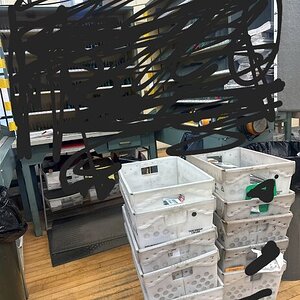
HOW the !@#$% is even legal to do??? 10 full tubs.
One not filled to top have Sam's club. Utterly ridiculous andour union is perfectly fine with this BS.View attachment 16270
I am sure these all came on a Monday...? There is absolutely no reason why these couldnt go out sparingly thru the week to even the mail volume so to speak-yet I am sure your office is like mine and all must go the day we receive it..I agree totally this is just not right.
No on Saturday. Haven't a seen single tub flat Tuesday through Friday then ta-da.
ALL THERE.
Slogan in our office. EVERY PIECE EVERY DAY
From The Nat'l Agreement ;No on Saturday. Haven't a seen single tub flat Tuesday through Friday then ta-da.
ALL THERE.
Slogan in our office. EVERY PIECE EVERY DAY
ARTICLE 30
WORKING RULES FOR RURAL CARRIERS
Section 1. General Provisions
A. Even Flow of Mail
The Employer shall make every effort to maintain consistent
processing of mail.
File on this.
From The Nat'l Agreement ;
ARTICLE 30
WORKING RULES FOR RURAL CARRIERS
Section 1. General Provisions
A. Even Flow of Mail
The Employer shall make every effort to maintain consistent
processing of mail.
File on this.
They claim the plant had machine down. Union was perfectly fine with it. Just flat out ridiculous
That excuse might work for THIS time. But a proper investigation of machine run time for the past several months as well as RADAR reports showing the gross disparity between the actual numbers on given days would reveal otherwise. We all understand Mondays and days after Holidays. However, while we as carriers may walk into chest high stacks of buckets on those days , the time and day(s) that mail was run is on the tags. So, when you walk into 10 buckets on a Monday, you SHOULD see that roughly half were run on Sunday and the other half on Monday.They claim the plant had machine down. Union was perfectly fine with it. Just flat out ridiculous
It’s about building a paper trail and showing the development of patterns. It takes time and patience plus refusing to back down. Good luck if you choose to be the thorn it is extremely exhausting trust me I know.They claim the plant had machine down. Union was perfectly fine with it. Just flat out ridiculous
BraveHrt68
Active member
Your drive time is the same for every day. When you whiz by boxes...your coverage factor time goes down for that day...not your drive time. The only time your drive time is affected is when you gain or lose boxes, miles or traffic control points. "The RRECS software totals all the individual interval times as calculated in the above example and arrives at a Daily Drive Time that is MULTIPLIED by six to arrive at a weekly drive time." You cant multiply different daily drive times by six. If nothing changes on your route....your drive time is the same every day. If something does change... the daily drive to is recalculated...which can then be multiplied by six to give you your new weekly drive time.I'm wondering if this also affected the DSM for the day. What occurred with you in this instance is just MORE proof that this system is clearly not at all accurate. You stopped at every box. For all the system is SUPPOSED to know , you either delivered and / or collected mail from each box. That would be 100% service. Having said that, the time value for your miles for the day of the audit should also be very good. Meaning, the more stops per mile, the more the mile is worth. The examples from The Guide state this :
A. A mile in which the rural carrier is in a neighborhood and stops every 100 feet or so
to service a box: In this example the mile is divided in approximate 53 intervals of
100 feet. Looking at the DSM above we multiply each 100‐foot interval by 0.00128
minutes/foot and get 0.128 minutes per interval times 53 intervals equals 6.78
minutes per day or 40.7 minutes per week driving time for this mile of the route.
B . A mile in which the carrier stops for boxes that are more spread out and 1/10 of a
mile apart: In this example the mile is only divided into 10 intervals of 528 feet.
From DSM, we multiply each 528‐foot interval by 0.00067 minutes/ft and get 0.354
minutes per interval times 10 intervals equals 3.54 minutes per day or 21.23 minutes
per week driving time.
C. A mile of “dead‐head” in which the carrier makes no stops for boxes or traffic
control points: In this example the mile is one interval of 5280 feet. From DSM we
multiply 5280 feet times 0.00029 minutes/ft and get 1.53 minutes per day or 9.19
minutes per week driving time.
And I do get it. Some days you whiz by boxes so for THAT day your drive time goes down. However, there are days just like the one you experienced where you stop at every box which would increase the drive time for THAT day which would help you on the overall average for the weekly drive time you see on the 4241A. Now, this was referred to as a GPS audit. The PO was thinking they were auditing you / the route but that was a big backfire. That's good !!!. Now, you can let the engineers , Postal Headquarters, our union, Eagan, etc. , know just how this system cannot be relied upon.
blue_goose1348
Well-known member
This is correct. I am surprised you had the courage to stick your neck out and post it!Your drive time is the same for every day. When you whiz by boxes...your coverage factor time goes down for that day...not your drive time. The only time your drive time is affected is when you gain or lose boxes, miles or traffic control points. "The RRECS software totals all the individual interval times as calculated in the above example and arrives at a Daily Drive Time that is MULTIPLIED by six to arrive at a weekly drive time." You cant multiply different daily drive times by six. If nothing changes on your route....your drive time is the same every day. If something does change... the daily drive to is recalculated...which can then be multiplied by six to give you your new weekly drive time.
Well, I hope the both of you are correct. I stated, " I was wondering" , because if RRECS isn't compensating us for NOT servicing different boxes on particular days , why would that same program include the "not serviced" boxes in the DSM on a daily basis ? And I mean active boxes . Just no mail service on any given day(s). When @BraveHrt68 says , " You cant multiply different daily drive times by six. If nothing changes on your route....your drive time is the same every day. " , I disagree. You can have 6 totally different daily drive times and then add them all together and then divide by 6 to get the average drive time for the week. Just like 6 different coverage factors for a given week all added together and divided by 6 to the weekly coverage factor for that week. For now, I am going by The Guide where upon it repeatedly states "A mile in which the rural carrier is in a neighborhood and stops every 100 feet or so....." from example A in The Guide ," A mile in which the carrier stops for boxes that are more spread out...." from example B in The Guide , " A mile of “dead‐head” in which the carrier makes no stops for boxes or traffic......." from example C in The Guide. I keep seeing the word "stops" and even the "no stop" citation. I also see this in The Guide ;Your drive time is the same for every day. When you whiz by boxes...your coverage factor time goes down for that day...not your drive time. The only time your drive time is affected is when you gain or lose boxes, miles or traffic control points. "The RRECS software totals all the individual interval times as calculated in the above example and arrives at a Daily Drive Time that is MULTIPLIED by six to arrive at a weekly drive time." You cant multiply different daily drive times by six. If nothing changes on your route....your drive time is the same every day. If something does change... the daily drive to is recalculated...which can then be multiplied by six to give you your new weekly drive time.
This is correct. I am surprised you had the courage to stick your neck out and post it!
RRECS contains algorithms that identify the
time that a vehicle stops and the time that
it starts again from the GPS breadcrumb
data generated by the MDD.
RECS uses algorithms and the pooled data to
estimate when the device speed falls below
a specified threshold (about walking speed)
and defines this as a stop.
On any given day, an interval between two
mapped stops is defined as a valid interval if
the daily breadcrumb path indicates a stop at
both locations and no unidentified stops occur
between them.
I looked at 3 or 4 of my 4241As and saw different drive times and that's with only the occasional change of one or two boxes from active to vacant or vice versa. So, nowhere near enough change to really impact drive time. As I said, I hope the both of you are correct. Not that I was "wrong" because I was just wondering / thinking.
Last edited:
jsthere723
Well-known member
Just a caveat though. It is true that no change in delivery and line of travel , drive time should remain the same . However system is notoriously known for dropping TCPs without any apparent reason. That being the case drive time will differThis is correct. I am surprised you had the courage to stick your neck out and post it!
BraveHrt68
Active member
I was just trying to set your mind at ease(wondering/thinking). Showing you that it states in the guide that it MULTIPLIES the daily drive time by 6( doesnt add them up and divide by 6). At least you are reading the guide. Most of the carriers at my office dont even read it. Sad but true.Well, I hope the both of you are correct. I stated, " I was wondering" , because if RRECS isn't compensating us for NOT servicing different boxes on particular days , why would that same program include the "not serviced" boxes in the DSM on a daily basis ? And I mean active boxes . Just no mail service on any given day(s). When @BraveHrt68 says , " You cant multiply different daily drive times by six. If nothing changes on your route....your drive time is the same every day. " , I disagree. You can have 6 totally different daily drive times and then add them all together and then divide by 6 to get the average drive time for the week. Just like 6 different coverage factors for a given week all added together and divided by 6 to the weekly coverage factor for that week. For now, I am going by The Guide where upon it repeatedly states "A mile in which the rural carrier is in a neighborhood and stops every 100 feet or so....." from example A in The Guide ," A mile in which the carrier stops for boxes that are more spread out...." from example B in The Guide , " A mile of “dead‐head” in which the carrier makes no stops for boxes or traffic......." from example C in The Guide. I keep seeing the word "stops" and even the "no stop" citation. I also see this in The Guide ;
RRECS contains algorithms that identify the
time that a vehicle stops and the time that
it starts again from the GPS breadcrumb
data generated by the MDD.
RECS uses algorithms and the pooled data to
estimate when the device speed falls below
a specified threshold (about walking speed)
and defines this as a stop.
On any given day, an interval between two
mapped stops is defined as a valid interval if
the daily breadcrumb path indicates a stop at
both locations and no unidentified stops occur
between them.
I looked at 3 or 4 of my 4241As and saw different drive times and that's with only the occasional change of one or two boxes from active to vacant or vice versa. So, nowhere near enough change to really impact drive time. As I said, I hope the both of you are correct. Not that I was "wrong" because I was just wondering / thinking.