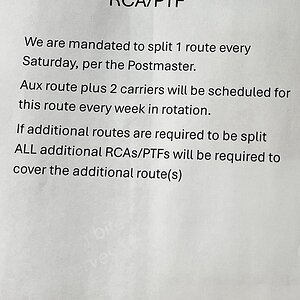
• Everyone, please help make our jobs easier and choose the correct category. Thank you

Did we ever find out what happens when our route is split?

Does the route being split hurt your evaluation?

  • Yes

    Votes: 37 100.0%
  • No

    Votes: 0 0.0%

  • Total voters
    37
Thank you sound exactly what I do except we go into pm casing and keep track of miles. I went 40 miles today and on the computer they put in 40 on deviation for those So I’m just unsure if the pm casing. I’ve just seen things for the 2nd trip and that all. That’s how we’ve been doing it. And we make sure to do all the other scans for RRECS also We have been getting it for the hours. It’s being put into the computer right, we’re just unsure of what to do on our scanner. So the only thing we seem to do different is the pm casing
Thank you so much for your help
You are doing it correctly. If clocking out on your original route, the carrier would be shown to be working off the clock. In pm casing, then switching to split route, is the only way that a carrier could record and enter into the split route's data additional load time. If a " "helping" carrier doesn't enter pm casing on original route, all the time spent on the route they're splitting would be entered in on original route as EOS time. Which is fine with me if your pm is stupid enough to allow it.
Carriers please check, if you dont believe me, that any load time entered on any route after "depart2route" is entered is NOT recorded, UNLESS pm casing is entered first. Ask your manager to look at load times for the route in question. It will only show one start load and one end load time. If ANY other load time is attempted after depart2route, that start load/end load is not entered into route's data. This also includes routes that "re-load" half way through their routes everyday. Look and you will NOT see any load time on the management computer for those load times. That's why 2nd trips are to be done in pm casing and not during the route's 1/2 way point.
 
You are doing it correctly. If clocking out on your original route, the carrier would be shown to be working off the clock. In pm casing, then switching to split route, is the only way that a carrier could record and enter into the split route's data additional load time. If a " "helping" carrier doesn't enter pm casing on original route, all the time spent on the route they're splitting would be entered in on original route as EOS time. Which is fine with me if your pm is stupid enough to allow it.
Carriers please check, if you dont believe me, that any load time entered on any route after "depart2route" is entered is NOT recorded, UNLESS pm casing is entered first. Ask your manager to look at load times for the route in question. It will only show one start load and one end load time. If ANY other load time is attempted after depart2route, that start load/end load is not entered into route's data. This also includes routes that "re-load" half way through their routes everyday. Look and you will NOT see any load time on the management computer for those load times. That's why 2nd trips are to be done in pm casing and not during the route's 1/2 way point.
So why is it on still on our screen during “depart to route” if we can’t use it to “re-load” half way through the route? They continually steal from us in every aspect and nothing happens to protect us from all this wage theft. The sad part is they do sneakily too! Just like a criminal would do!
Does multiple load times in the morning before we depart actually get credited correctly?
Isn’t that the reason they removed the “carrier pick ups” from the “return to office” screen, to stop that on eos time?
 
So why is it on still on our screen during “depart to route” if we can’t use it to “re-load” half way through the route? They continually steal from us in every aspect and nothing happens to protect us from all this wage theft. The sad part is they do sneakily too! Just like a criminal would do!
Does multiple load times in the morning before we depart actually get credited correctly?
Isn’t that the reason they removed the “carrier pick ups” from the “return to office” screen, to stop that on eos time?
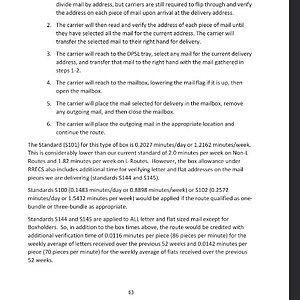
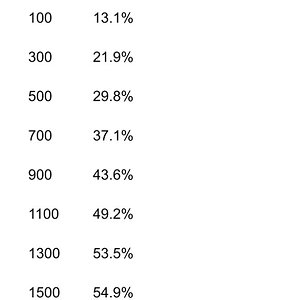
When you refer to "reload" , are you referring to actually loading the portion of the split route or the rearranging aspect ? Reload is based upon formulas. Pages 94 and 95 of The Guide explain it all. I am not saying that it is correct, accurate, or even works when a route is split but it's all we have ( are allowed to see anyway ) . In part ;


42. Reload Allowance

The Reloading standards in RRECS are best illustrated by the Lookup Tables below which
simplify the standard by number of trays (determined from mail volumes) and bundling
system. Unloading time is now included in the EOS Duties and recorded as actual time
each day.

The rest of the page from which the above came , page 94, and page 95 explain the formulas.
 
When you refer to "reload" , are you referring to actually loading the portion of the split route or the rearranging aspect ? Reload is based upon formulas. Pages 94 and 95 of The Guide explain it all. I am not saying that it is correct, accurate, or even works when a route is split but it's all we have ( are allowed to see anyway ) . In part ;


42. Reload Allowance

The Reloading standards in RRECS are best illustrated by the Lookup Tables below which
simplify the standard by number of trays (determined from mail volumes) and bundling
system. Unloading time is now included in the EOS Duties and recorded as actual time
each day.

The rest of the page from which the above came , page 94, and page 95 explain the formulas.
That reload is for moving your back of truck to the cabin though?

I think their reload is more 2nd trip, or coming back to the office mid-delivery, or picking up a piece if a split route?
 
That reload is for moving your back of truck to the cabin though?

I think their reload is more 2nd trip, or coming back to the office mid-delivery, or picking up a piece if a split route?
Yeah. That's why I was asking in my previous post when I asked , " When you refer to "reload" , are you referring to actually loading the portion of the split route or the rearranging aspect ? " I wasn't sure which "load" was being questioned. I was thinking more like you are saying with the coming back to the office and things of that nature. We really should not be doing that or taking a portion with us and then doing that portion after we are finished with our route. You know, going from our last box to immediately going to do the portion of the split route. Should always come back to the office first and then do any help. Remember, LOT is important for our assigned route AND the split route.
 
When you refer to "reload" , are you referring to actually loading the portion of the split route or the rearranging aspect ? Reload is based upon formulas. Pages 94 and 95 of The Guide explain it all. I am not saying that it is correct, accurate, or even works when a route is split but it's all we have ( are allowed to see anyway ) . In part ;


42. Reload Allowance

The Reloading standards in RRECS are best illustrated by the Lookup Tables below which
simplify the standard by number of trays (determined from mail volumes) and bundling
system. Unloading time is now included in the EOS Duties and recorded as actual time
each day.

The rest of the page from which the above came , page 94, and page 95 explain the formulas.
Rearranging aspect. Moving mail and packages up to the front of the vehicle.
 
Rearranging aspect. Moving mail and packages up to the front of the vehicle.
Well then , that time would be automatically calculated based upon the formulas. There would be no start load or end load for THAT. Only start load and end load for when you are actually loading that mail and parcels for the split route at the office.
 
If split routes are done properly, those routes should gain more time that normally because there are 2 (or more) carriers that are doing some of the same things. There must be one carrier that accepts responsibility to enter depart2route and return2du. The other/s (while in pm casing) should enter start load/end load times when they load or when they return and unload (until their clock out time) to capture the time it takes on the EOS time on the split route. There is no other way to capture this time except by the one splitting carrier that accepts that responsibility.
There is no good reason why we are able to enter start load end load after we have entered depart2route, and not have that time show up on our radar report, but it's probably so carriers like me don't gain all kinds of extra time while driving around on their routes entering various things.
 
Back
Top