• Everyone, please help make our jobs easier and choose the correct category. Thank you

Cutting a route under RRECS, calculations?

Meklin89

New member
Does anyone know or understand how routes cuts will be calculated? Is it similar to the old system, or some convoluted process that involves each line on the 4241-M for each stop moved from one route to another?

My route went from 55:20 to 67:02. I understand management can and will likely cut me to a 43k, (51-52:11), so my route can lose up to 15-16hours.

I also assume local management determines what address get moved to where. I’ve been saying my route is overburdened for 2 years and finally have the Proof needed to go to my sup and ask for a route cut.

Any information of how route cuts work under RRECS would be appreciated!
 
I wish I knew. I'm at 58.41. I'm the only rural route in the area. Next year we're planning to absorb the highway contract route because she's retiring. That will make two nice rural routes. Until then I guess I just keep working 60 hour weeks?
Both city routes would happily give territory away, they are too big as well, but unions won't allow it.

It's not my job description to know, but I sure want to.
 
I asked this question during the mini mail survey zoom meetings. Basically the stewards brushed me off saying boxes, miles, etc like normal. AND…they cited the MOU that a carrier has to volunteer to cut their route before Oct 2023. They really don’t know the answer is what I took from their response. Meanwhile routes higher than a 48K have no means to be paid above that and are doing extra work for free.
 
If you can make sense of it, this is for a new Aux, but assume process would be same:

12. CALCULATING BASE HOURS ON NEW AUXILIARY ROUTES AFTER ROUTE ADJUSTMENT
A. Background Adjusted Routes
Local managers need a simple procedure to estimate base hours on newly created auxiliary routes after route adjustments. In the discussion that follows, we will refer to the new auxiliary route that is created as the aux route, and the existing adjusted route or routes as donor routes.
Carriers on both the aux and donor routes must be paid immediately after the adjustment. While RRECS procedures for new routes can produce interim evaluations after 13 weeks of data collection, they do not include a procedure for setting evaluations for the first 13 weeks after adjustment. This section of the report describes the automated procedure that will be used during this initial 13-week period.
B. Business Logic Adjusted Routes
The donor route contributes time to the aux for the following 10 transfers: Route miles; Regular boxes; Central boxes; Dismounts; Dismount distances; Inter-unit mail (low volume); Inter-unit mail (high volume); Collection points (blue box); Collection compartments; and Mail Volume. These are the same 10 items used to adjust base time in interim adjustments. The Postmaster enters the amount of the transfer for eight of the ten items (excluding Route Miles and Mail volume) and the business logic calculates the time transferred to the aux route. For Route miles, the Postmaster must enter three pieces of information: the pre-transfer mileage and the drive time (basic route) for the donor route; and the miles transferred from the donor to the aux route. The business logic calculates the standard time for the transferred miles from these three data points. For Mail volume, the Postmaster enters the volume factor of the donor route, and the business logic calculates the standard time for the mail volume transferred from the donor to the aux route. The process is repeated for each donor route.
The total time from the 10 calculations represents the time by which the donor base hours are reduced. The total time for the new auxiliary route is equal the sum of the time transferred from each donor route plus the time for fixed time activities, actual time activities, additional miles on the auxiliary route, and office walking. To determine fixed time, the Postmaster must enter the withdrawal option and the vehicle type on the aux route. The business logic selects the appropriate fixed time for the combination entered. Actual times on the aux route are based on average times for load vehicle and end-of-shift activities. No entries are necessary. Additional miles are the stem and connecting segments that link transferred miles to the delivery unit and each other. The Postmaster must estimate these miles (Google Map, driving) and enter the total additional miles. Finally, office walking requires the carrier and supervisor to take the actual measurements for the new auxiliary route. The business logic calculates total standard minutes for the aux route by adding transferred, fixed, actual, additional miles and office walking minutes. The logic automatically calculates base hours for the new auxiliary route.
The route adjustment process requires the Postmaster to enter 12 pieces of information for each donor route and 3 pieces of information for the new auxiliary route. All calculations are automated. The output shows the base hour deductions from each donor route and the base hours for the auxiliary route.
 
The donor route contributes time to the aux for the following 10 transfers: Route miles; Regular boxes; Central boxes; Dismounts; Dismount distances; Inter-unit mail (low volume); Inter-unit mail (high volume); Collection points (blue box); Collection compartments; and Mail Volume.
I did find this a little bit ago, and it kinda makes sense in my head. Kinda.

For Mail volume, the Postmaster enters the volume factor of the donor route, and the business logic calculates the standard time for the mail volume transferred from the donor to the aux route. The process is repeated for each donor route.

The problem I see with this is this part. From what I understand everyone’s volume factor shows 0 on the 4241. How do you cut 16 hours when volume shows 0?

Do I lose a large chunk of my route, and then every time the BH are calculated my route slowly loses time due to losing all the associated volumes for stops moved from my route, until a year from then when it would likely drop to an Aux route?
 
Do I lose a large chunk of my route, and then every time the BH are calculated my route slowly loses time due to losing all the associated volumes for stops moved from my route, until a year from then when it would likely drop to an Aux route?
Thats (what I think) is a major error on the forms. I can’t find anything that says there is no volume factor, and places like this one that says it’s used. My thinking is there can’t be a zero in the field, so must be an error, and the evaluations are wrong. My opinion anyway. I’ll be asking ADR for clarification as I hope everyone else with a zero is.
 
Thats (what I think) is a major error on the forms. I can’t find anything that says there is no volume factor, and places like this one that says it’s used. My thinking is there can’t be a zero in the field, so must be an error, and the evaluations are wrong. My opinion anyway. I’ll be asking ADR for clarification as I hope everyone else with a zero is.
So far as I’ve seen all routes were printed with a 0 volume factor. My DR did not have an explanation & has yet to receive their 4241s yet.
 
I asked this question during the mini mail survey zoom meetings. Basically the stewards brushed me off saying boxes, miles, etc like normal. AND…they cited the MOU that a carrier has to volunteer to cut their route before Oct 2023. They really don’t know the answer is what I took from their response. Meanwhile routes higher than a 48K have no means to be paid above that and are doing extra work for free.
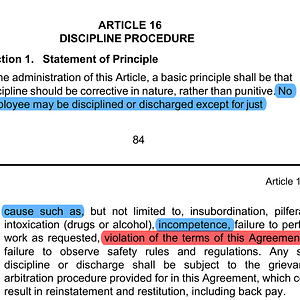
Your Stews were incorrect in the MOU interpretation. Mgmt CAN cut a route if they choose to whether the Carrier volunteers or not. They need only to be in the 47-48k range. What the MOU does do is require mgmt to cut a route if the Carrier requests it when they reach 47k or above.
 
Your Stews were incorrect in the MOU interpretation. Mgmt CAN cut a route if they choose to whether the Carrier volunteers or not. They need only to be in the 47-48k range. What the MOU does do is require mgmt to cut a route if the Carrier requests it when they reach 47k or above.
I'm the only donor route. I'm desperate to be cut. I'm the only rural route in the area. I'm a 58.41. So what happens when there's not enough to make an aux? How few hours can an aux be? If there are zero other rural employees, who runs it?
 
I'm the only donor route. I'm desperate to be cut. I'm the only rural route in the area. I'm a 58.41. So what happens when there's not enough to make an aux? How few hours can an aux be? If there are zero other rural employees, who runs it?
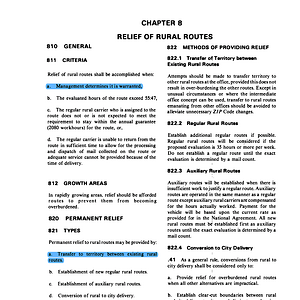
Although pulling from your route may be viewed as small time, the basics will add to those deliveries and could qualify as a Auxiliary at 12 hours.
 
I did find this a little bit ago, and it kinda makes sense in my head. Kinda.


The problem I see with this is this part. From what I understand everyone’s volume factor shows 0 on the 4241. How do you cut 16 hours when volume shows 0?

Do I lose a large chunk of my route, and then every time the BH are calculated my route slowly loses time due to losing all the associated volumes for stops moved from my route, until a year from then when it would likely drop to an Aux route?
This kinda follows my concern. I was a 46k barely making evaluation now I'm a 44k. The amount of time it takes to do my route isn't going to change so now I'll be way over evaluation. So now what management says get back within evaluation or we cut the route down. How will that help if the evaluation is off? Ok let's take away stops so now rrecs will auto recalculate to an even lower evaluation but the evaluation is still off because the evaluation was wrong to begin with. So now I'm over that evaluation so we cut again and again till there is nothing left!
 
Back
Top