If I follow what you are writing you are suggesting that we have something similar to case law in our grievance system.
As we are supposed to mirror the Federal Legal system and have had grievances that were used to interpret rules, I think your logic stands on this.
Of the three explicit grievance categories (interpretive, administrative, compliancy), if the purpose of "interpretive" grievances are something
other than "to yield an interpretation", then I am misunderstanding their intent and purpose.
As for your estimate of what human nature should be I think your expectations are too high.
Being a broad, subjective estimate, perhaps. Opinions vary, and just because it’s my standard doesn't inherently mean I've personally satisfied it. I'm convinced multi-tiered standardization would be more beneficial than not, even if not set to my ideals. I believe would be a less abstract method of gauging a rep's familiarity than "oh, they're a good/bad steward", and may somewhat relax the effects of those who are just charming.
The good stewards are stretched thin solving what amounts to the same problem again and again. The other stewards don’t know how to go beyond cookie cutter answers.
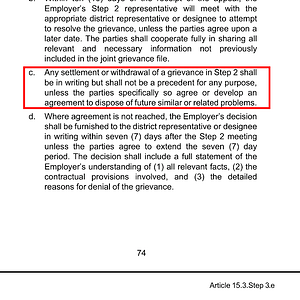
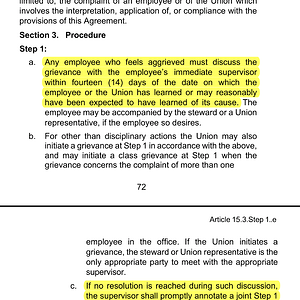
I understand that repetitive issues could be knocked out through grievances at step 2:
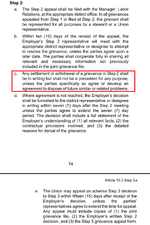
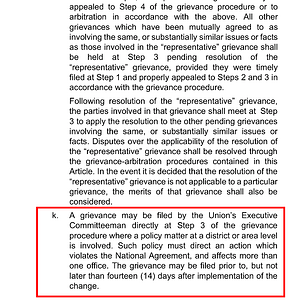
and/or initiating at step 3:

A cumulative monetary penalty would likely reduce the issue, and if not, carriers would just keep getting paid for violations. There's also settling the grievance through district/area management adopting a policy.
For some reps, cookie-cutter answers in this
particular field is their glass ceiling. Sometimes, they have the ability to go beyond that, they just don't know how to access that side of themselves, or don't have enough examples to learn by analogy. Teaching and learning styles don't always connect either.
I am 69 and still meet people that believe they are older and wiser than I am.
In some aspects and in some fields they may or may not be wiser, depending how "wiser" determined. Age is a simple number comparison. That one seems simple to me, unless "age" as used here means "life-obstacle experience".
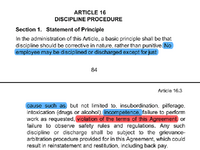
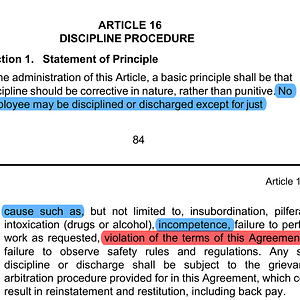
In my day we were told we are not supposed to look for potential problems to file grievances on.
Unfortunately, it is not how you play the game but whether you win or lose that counts.
I've heard the same "don't look for potential problems" mantra from my rep days. Given the enforcement rights that reps have, the mantra translated to me as dissuasive innuendo.
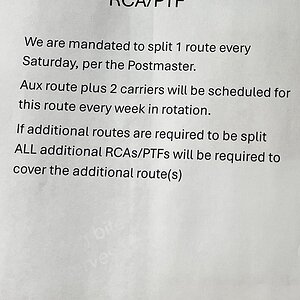
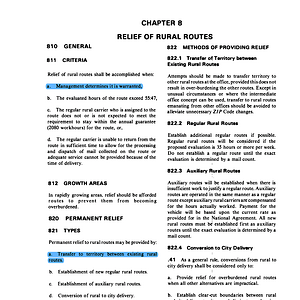
Once one understands that the leave replacement assignment list can't have one RCA in multiple primary regular route positions, they're not really
looking for anything; it just stands out.
As to looking for potential problems to
file on, "filing a grievance" depends on management's response to the complaint.
Using my earlier example, if a rep tells the supervisor that management is not supposed to have the same RCA in multiple primary regular route positions on the matrix, and the supervisor tells the rep to go pound sand, does the NRLCA get upset if the rep files on the violation, or do they get upset for the rep settling that step 1 grievance discussion (because that's where the dispute is at that time) by letting it slide?

That's one point that I never understood with the NRLCA.
In my experience with union meetings, the union boasts about
defending the contract with a presumption that typical bargaining unit members are
less knowledgeable in the material than the reps are, yet simultaneously require these
less knowledgeable bargaining unit members to lead the charge in defending the contract.

If that's indeed the mentality, then,
as a bargaining unit member who's supposed to lead the charge, the union and management providing me with parameters (such as a clear method to aquire interpretations of work rules) is a first-principle of determining what constitutes a violation. Either that or I use the spaghetti pot method and make accusations I cannot clearly articulate, just to see what sticks.
I'm just trying to find a clear and reliable method I can use to get a reliable interpretation of the terms and conditions of my employment. If no way exists, I think it's fair to expect a settlement that identifies "no method exists for a carrier to aquire interpretations of their conditions of employment."