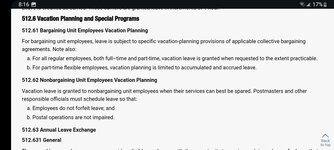
Given the context (please correct me if I'm mistaken), I think you meant "ratified", and not "verified".
- Under Article 12 of the NRLCA National Constitution, the Association grants parliamentary authority to Robert’s Rules of Order Newly Revised (RONR)
- Under RONR, the motion to ratify (also called approve or confirm) is a motion that is used to confirm or make valid an action already taken that cannot become valid until approved by those entities with the power to vote for ratification.
- The Association must offer its ratifying voters the contract it had agreed to with the Employer under proviso of a successful ratification. The question being, "shall we ratify X?", not, "shall we ratify some derivative of X?"
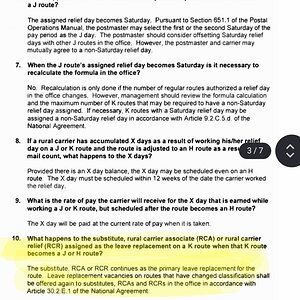
- The Association's duty of fair representation does not authorize the Association to bait its ratification voters with one contract, modify the terms of the contract after ratification, then switch the ratified contract with an amended version after the fact.View attachment 12909
As for the Questions and Answers posted on the Union website, last I checked, there was no affirmation of any joint agreement from any USPS Headquarters-level executive that the questions and subsequent answers were the Employer's responses to those questions.
In past "Q & A" segments, it was clear that the questions were the Union's questions, and the answers were the Employer's answers. However, in today's great Q & A listing, I don't know whose questions those are, nor do I know who answered them. For all I know, the Union just answered a bunch of its own questions. If so, those questions and answers have no inherent weight or binding effect with the USPS.
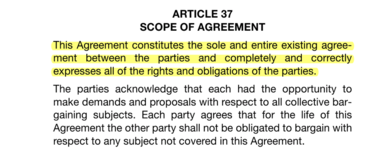
In terms of contractual elements, if the union examines its
own words, the union has transformed "what could be" (X
may include Y) into "what is" (X
is Y). These elements are extremely different, and a different reliance results from each. It's not just a slight refocusing, it's an entirely different meaning than what was originally offered, and later accepted via ratification.
I need further explanation on this point to accept it. There may be some terminology isses we'd need to first resolve for minds to meet.
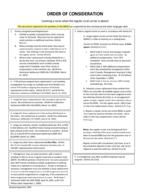
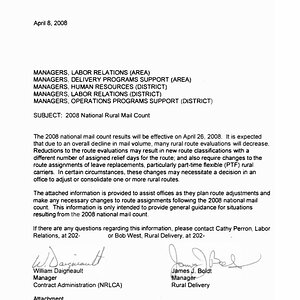
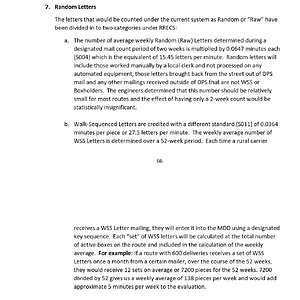
By "opinions" I presume you mean "binding opinions" such as those resolved through arbitration. If this presumption is correct, then board members don't issue opinions (in this sense) either. The Association could issue a position statement (such as that in the Order of Consideration document), but that position is not binding on the Employer, and lacks the force an arbitration opinion carries.
View attachment 12908
National Officers are not "professionals" in the sense that lawyers and judges are. (This is a major factor as to why union officials have so very little liability risk). While there is a "duty of fair representation" obligation, the bar to meet that requirement is low. I'm talkin' "discount sale at the dollar store" kind of low.
While I hope they really "give it their all", the Association has no standards of excellence, nor any competency examinations to become a National Officer. I hope they know their stuff, I'm just not convinced that they all do.