You are using an out of date browser. It may not display this or other websites correctly.
You should upgrade or use an alternative browser.
You should upgrade or use an alternative browser.
Pre-paid vacation
- Thread starter Heyyou
- Start date


PapahSmurf
Well-known member
Did you submit the receipt that shows you paid?
I believe you have to have all this done prior to purchasing. Request leave, indicate it's going to cost "X" amount, with proof, and they approve. I don't recall they HAVE to approve leave just because it's an expensive investment. They just have to approve or deny with large lead times for expensive vacations.I put in a leave slip 60 days in advance, for my vacation, that I paid for. It was denied. I though they had to approve pre-paid vacations.
Feel free to correct me if I'm mistaken.

Dominator
Well-known member
- Go on eLRA and put a request in daily.
- File a 3971 at the end of each workday (after RETURN2DU but before CLOCKOUT.)
- Grieve EVERY denied slip and request union presence for EACH discussion.
To my knowledge, @Old Fart is right in that expenses related to the reason for requesting annual leave is not a relevant factor as to whether the leave is approved.
It can become relevant though if the leave is inappropriately denied, and the carrier incurs unnecessary expense due to management's error. The presence of this risk is usually what compels management to approve the request. The manager doesn’t want a grievance settlement resulting in a letter of demand over their head.
Good luck, and don't give up!


Last edited:
Heyyou -- "I put in a leave slip 60 days in advance, for my vacation, that I paid for. It was denied. I though they had to approve pre-paid vacations."
-- Section 7.A. Leave Submission
- Requests for annual leave will not be accepted prior to sixty ( 60 ) days in advance of the desired leave date or service week. Leave requests may be submitted further in advance for exceptional circumstances.
-- While the new addition to the 2021-2024 contract does mention "exceptional circumstances", there is no mention of pre-paid or incurring other expenses associated with the leave request.
-- Try adding "pre-paid" expenses to the Thread about new resolutions.
-- What was the reason for the denial of your leave? Too far in advance? No leave replacement available?
-- Shows the sorry state of affairs at the USPS if they are unable to have someone ready to run a route within 60 days.
pomastercontrolsmyfreedom -- "My union rep never answers the phone or returns messages."
-- If it is the office steward, contact your Assistant District Representative.
-- If it is the Assistant District, contact your District Representative,
-- If the DR, contact NRLCA HQ.
-- If it is the office steward, contact your Assistant District Representative.
-- If it is the Assistant District, contact your District Representative,
-- If the DR, contact NRLCA HQ.
The documentation is there.Heyyou -- "I put in a leave slip 60 days in advance, for my vacation, that I paid for. It was denied. I though they had to approve pre-paid vacations."
-- Section 7.A. Leave Submission
- Requests for annual leave will not be accepted prior to sixty ( 60 ) days in advance of the desired leave date or service week. Leave requests may be submitted further in advance for exceptional circumstances.
-- While the new addition to the 2021-2024 contract does mention "exceptional circumstances", there is no mention of pre-paid or incurring other expenses associated with the leave request.
-- Try adding "pre-paid" expenses to the Thread about new resolutions.
-- What was the reason for the denial of your leave? Too far in advance? No leave replacement available?
-- Shows the sorry state of affairs at the USPS if they are unable to have someone ready to run a route within 60 days.
Attachments

Receipts may be requested, so if anything you need to buy tickets First.I believe you have to have all this done prior to purchasing. Request leave, indicate it's going to cost "X" amount, with proof, and they approve. I don't recall they HAVE to approve leave just because it's an expensive investment. They just have to approve or deny with large lead times for expensive vacations.
Feel free to correct me if I'm mistaken.
Attachments

You only do that if requested. If they denied it w/out requesting it's a clear grievanceDid you submit the receipt that shows you paid?
Augsburg et al -- "Receipts may be requested, so if anything you need to buy tickets First."
-- Please note that the examples provided in the "Tentative-Agreement Highlights":
- Life events such as weddings, graduations, etc
- Pre-paid vacations, cruises, packages (?), travel tickets, etc
- Documentation may be requested
Did not make it into the final 2021-2024 National Agreement.
-- Only "Leave requests may be submitted further in advance for exceptional circumstances." did make it into the final contract wording.
-- Something manglement probably will be most happy to point out.
-- Possibly your ADR or DR can step in to get manglement to see the error of their denial of leave for an "exceptional circumstance".
-- Good luck.
Voglio-il mio
Well-known member
Article 10. Section 7.I believe you have to have all this done prior to purchasing. Request leave, indicate it's going to cost "X" amount, with proof, and they approve. I don't recall they HAVE to approve leave just because it's an expensive investment. They just have to approve or deny with large lead times for expensive vacations.
Feel free to correct me if I'm mistaken.
Leave Submission
A. Requests for annual leave will not be accepted prior to sixty (60) days in advance of the desired leave date or service week. Leave requests may be submitted further in advance for exceptional circumstances. Leave requests received on the same day will be considered in order of seniority.
B. Failure to return a request for leave within three (3) days of receipt will result in the request being automatically approved, provided the rural carrier has obtained proper acknowledgment of the leave request submission.
Dominator
Well-known member
The "exceptional circumstances" wording in 10.7 is needless garbage.
For those who have ever handled (or experienced) attendence-related discipline, you may recall management's argument including a concept amounting to "failure to maintain a regular schedule". Well, a presumption in this premise is that a "regular schedule" exists, and that a carrier is obligated to "maintain" it.
Using that same premise, any "circumstance" that deviates from the "regular schedule" is an "exceptional circumstance". It is an "exception" to the rule of having a "regular schedule".
Your annual leave request will always be a request to acknowlege an "exceptional circumstance" to deviate from the regular schedule. The "circumstance" is annual leave, while the "exception" to the rule is their approval of your request. There can be no "circumstance" deemed "exceptional" prior submission of your request.
Ahh words... they mean things.
Absolutely. This is one of the MANY arguments I cited when I represented a coworker in an EEO complaint. I asked , " Just what is the definition of regular in attendance ?" Now, I know there is no definition and that's why I asked. Just to hear the PO stumble, mumble, and fumble in front of The ALJ. Can an employee be absent from duty once a month ? Twice a week ? Three times a year ? I have a ton of AL, if I use one day a week am I also " not regular in attendance" ?For those who have ever handled (or experienced) attendence-related discipline, you may recall management's argument including a concept amounting to "failure to maintain a regular schedule". Well, a presumption in this premise is that a "regular schedule" exists, and that a carrier is obligated to "maintain" it
Dominator
Well-known member
Exactly.Absolutely. This is one of the MANY arguments I cited when I represented a coworker in an EEO complaint. I asked , " Just what is the definition of regular in attendance ?" Now, I know there is no definition and that's why I asked. Just to hear the PO stumble, mumble, and fumble in front of The ALJ. Can an employee be absent from duty once a month ? Twice a week ? Three times a year ? I have a ton of AL, if I use one day a week am I also " not regular in attendance" ?
System failure if you brought up the Saturday Leave provision for LWOP.
If there were a leave replacement available every Saturday from the beginning of my career appointment to my retirement date, and I exercised my right under 10.4. B to utilize that leave replacement every Saturday for every week for a LWOP day, would me having every Saturday off become my "regular schedule?"
If I worked just one of those Saturdays, do I risk discipline for irregular attendance because I came to work?
You may as well ask them how many hairs it takes to make a beard.
I used that one as well.Exactly.
System failure if you brought up the Saturday Leave provision for LWOP.
If there were a leave replacement available every Saturday from the beginning of my career appointment to my retirement date, and I exercised my right under 10.4. B to utilize that leave replacement every Saturday for every week for a LWOP day, would me having every Saturday off become my "regular schedule?"
If I worked just one of those Saturdays, do I risk discipline for irregular attendance because I came to work?
You may as well ask them how many hairs it takes to make a beard.
That's why they clarified.The "exceptional circumstances" wording in 10.7 is needless garbage.
For those who have ever handled (or experienced) attendence-related discipline, you may recall management's argument including a concept amounting to "failure to maintain a regular schedule". Well, a presumption in this premise is that a "regular schedule" exists, and that a carrier is obligated to "maintain" it.
Using that same premise, any "circumstance" that deviates from the "regular schedule" is an "exceptional circumstance". It is an "exception" to the rule of having a "regular schedule".
Your annual leave request will always be a request to acknowlege an "exceptional circumstance" to deviate from the regular schedule. The "circumstance" is annual leave, while the "exception" to the rule is their approval of your request. There can be no "circumstance" deemed "exceptional" prior submission of your request.
Ahh words... they mean things.
Attachments

But they did. The highlights are an interpretation/definition of the articles. You all are asking for clarification and the document has been provided. Just like the 603; when new definitions have not been established you go with the old. The highlights are essentially a new definition of the new points of the contract.Augsburg et al -- "Receipts may be requested, so if anything you need to buy tickets First."
-- Please note that the examples provided in the "Tentative-Agreement Highlights":
- Life events such as weddings, graduations, etc
- Pre-paid vacations, cruises, packages (?), travel tickets, etc
- Documentation may be requested
Did not make it into the final 2021-2024 National Agreement.
-- Only "Leave requests may be submitted further in advance for exceptional circumstances." did make it into the final contract wording.
-- Something manglement probably will be most happy to point out.
-- Possibly your ADR or DR can step in to get manglement to see the error of their denial of leave for an "exceptional circumstance".
-- Good luck.

Rt2mailman
Well-known member
How long of a period was it before the manager denied your leave? If it was immediately denied, then you should grieve that your manager did not apply any due diligence to see if an Rca could be hired, or if one was available from another office for those dates. Having not spent time doing that, your leave was denied unjustly. Rural carriers are supposed to be able to use their leave “as they wish”, if relief carriers are available. Without checking thoroughly there is no way to know if there was a relief carrier available. Some bigger offices often times have eager RCAs that would love to work one route for a couple of weeks.
What is your pm doing during your vacation time? He could carry it, and if he does a good job he could possibly have a Wednesday or Thursday off for a relief day.
What is your pm doing during your vacation time? He could carry it, and if he does a good job he could possibly have a Wednesday or Thursday off for a relief day.
Dominator
Well-known member
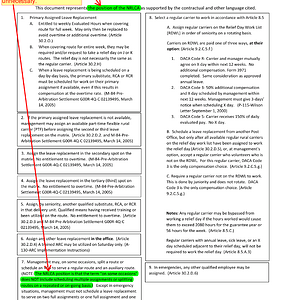
I don't know the source of the highlights image you posted. Would you please guide me to where you retrieved it? If there's an authority notice in there as well, please float it my way. I want to better understand your position, and have a fair chance to correct mine if yours is more convincing.But they did. The highlights are an interpretation/definition of the articles. You all are asking for clarification and the document has been provided.
I see in the contract in cases where definitions are provided, a precursor such as "[term] is defined as" or "for purposes of X, Y is defined as..." or similar, or a relevant section specifically titled as "definition" followed by whatever needs defined. I do not see any definitions in the contract under Article 10.7.
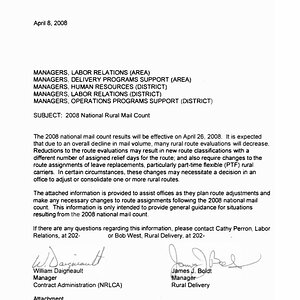
I've got this this notation which identifies explanations to what was once tentative terms as just "explanations", not interpretations/definitions.

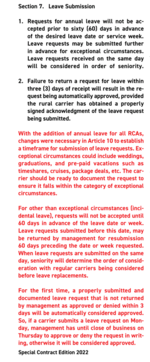
In the first red paragraph, second sentence, you'll notice that the explanation wasn't definitive. Rather than a definitive "does include" the explanation runs with a non-definitive "could include".
While it's possible I am mistaken, and your position is correct, the bullet points in the highlights you offered are incomplete sentences and/or incomplete thoughts. Additionally, with "etc." at the end, there is no limit to what applies. It's as though it's author wanted the conceptual force of a bright line rule, but was unwilling to determine what they wanted that line to be. The result is a big ol' bucket of

 .
Taking it a different direction, years ago, we had the "Analysis of Changes" handbook (identified as EL-902-A in the USPS Directives and Forms catalog (PUB-223)) Which included some explanations of a change and maybe some Q&A about the provision. The highlights you've presented, to my knowledge, aren't that either.
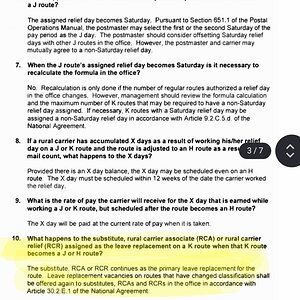
Yet one more direction, we turn to the RCAM.
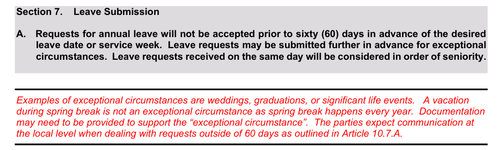
"Exceptional circumstances" here has a definitive "are weddings; are graduations; are significant life events. The red text indicates that these items would only permit submission greater than 60 days, however, it doesn't promise approval. While this is great and all, it wasn't at all the position presented in the 2021 tentative agreement.

Since it does not modify anything in any way, it cannot be used as a substitute for the actual contract as a sword (to attack the opposition's position), nor as a shield (to defend from the opposition's position). Yet, to me, this appears as exactly what's happening.
Unfortunately, documents cannot "speak for themselves". They are not witnesses, nor can one ask a document a question. I cannot ask the RCAM to explain why the explanation from the 2021 tentative agreement that was ratified by certain members does not match the explanations in the 2024 RCAM.
As for changes to the 603, old definitions are always obsolete. The only viable definition is whatever is current.Just like the 603; when new definitions have not been established you go with the old.
The Employer presents a change in an article 19 meeting. Whatever changes are ultimately accepted are inserted as authoratative into a Postal Bulletin issue, the previous language is replaced in the print, and eventually, a new 603 is printed with a transmittal letter declaring, "All previous issues of Handbook PO-603 are obsolete."
I disagree here. I'd agree that they are summaries. Arguing using summaries of the contract is not as potential as specifically using the contract text.The highlights are essentially a new definition of the new points of the contract.
Regardless what power 10.7 yields, I hope the outcome is @Heyyou getting the time off.