I'm reluctant to continue to engage with you because it's apparent you're not reading my replies, but I've got nothing better to do, so why not?
I'll say it again: the tasks associated with loading a vehicle are too varied from office to office (all the things I already listed in my previous response!) to come up with a standard time for this job task.
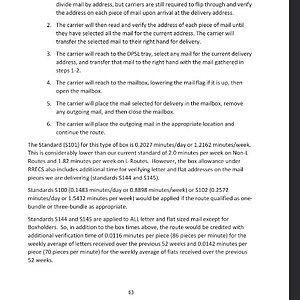
Let's look at another task that the engineers did come up with a standard time for: opening a mailbox, placing mail inside, closing mailbox. Not a lot of variables here. Whether I'm in an LLV or a Metris, or a POV, there's little difference between how this task is performed. Easy to measure, very few steps, simple to measure, and easy to come up with a time standard for reasonably experienced (or whatever the term they use) carriers to perform this task.
The job task of loading a vehicle (similarly to EOS) is too complicated to come up with a one-size-fits-all time standard. You're said "six experienced professors of Industrial Engineering could have come up with a standard time" but the fact is, six experienced professors of Industrial Engineering did look at this job task and determined they could not.
Your responses and comments are only serving to reinforce my own opinions to myself. Standards remove ambiguity that exists whenever different people do the same activity. Without standards, it’s easy to have conflicting views on how long a task should take, with each view having merit. A defined standard thus places restrictions on the methods timed to perform the task, restrictions that if mandated, can impair the efficiency of someone that has the ability to combine/consolidate tasks or use a different method.
A standard can be determined for loading. Distance, case to vehicle times walking speed. Number of small parcels times a factor. Number of medium parcels times a factor. Number of large parcels times a factor. Number of letters times a factor. Number of flats times a factor. Gov/pov times its perspective adjustment factor. That would do it, all of the data is already available. It wouldn’t be exact, no standard is, but it would be as accurate as the credit given for say a door delivery, and door delivery time is a larger time segment than vehicle loading time.
Once the standard is established, it is up to the carrier to decide how to arrange their activities, we get credit stipulated by the standard regardless of the time we actually consume. Without the standard, as in recording actual time, we are at the mercy of supervision dictating how we perform the task. The dictated method to perform the task interferes with our ability to perform at a higher level. Management becomes interested in minimizing the time of loading, and in so doing sub optimizers our ability to complete other aspects of our day as best we can.
As far as opening, filling, and closing a mailbox. Come on, what is the degree of blockage, is approach clear, are there potholes, is the mailbox regulation height, what size, construction material, condition is the mailbox in, does the metris door block elbow articulation. The time for servicing a mailbox is all over the map. Sure, it’s a small time, but multiply that small time by 500 mailboxes and it adds up.