• Everyone, please help make our jobs easier and choose the correct category. Thank you

Route cutting is ridiculous and stupid

I get that but I am talking volume wise too. It isn't even close.
Yes thank you for bringing that up. Volume is also the same. When they adjust routes everything in that route holds equal weight, but in reality each individual delivery will vary significantly. That’s what I mean about luck of the draw (sorry Shannonboy had to use this term again) as to what areas you get. You may end up with an area that has higher volume and vice versa. It’s really an older method of doing adjustments tied in with RRECS. So in a year from now what looks to be a 43K may actually be a 45/46K or the complete opposite J or H route when the data rolls in for those specific areas unfortunately.
 
I could have gained a section from another route that was a heavier volume section with an overall low volume factor attached to that section. I knew I could build it up when it merged with the rest of my territory and performance over the freeze. I didn't want to risk going overburdened again after the real evaluation kicked in. I was going to give up (by guestimate) more lower volume area to balance it out. We chose to not go that direction. I am relieved because it was very uncertain hiw it would play out in the end.
 
Yes thank you for bringing that up. Volume is also the same. When they adjust routes everything in that route holds equal weight, but in reality each individual delivery will vary significantly. That’s what I mean about luck of the draw (sorry Shannonboy had to use this term again) as to what areas you get. You may end up with an area that has higher volume and vice versa. It’s really an older method of doing adjustments tied in with RRECS. So in a year from now what looks to be a 43K may actually be a 45/46K or the complete opposite J or H route when the data rolls in for those specific areas unfortunately.
It is hard to explain to carriers. Only if you have done adjustments like you and I have, you understand how the worksheet calculates it. I wish it was that simple as some think. And this is why people will be very upset after they get cut and a year from now drop a lot or gain a lot. I really tried my best when cutting routes to talk to the carrier and find out the lighter / heavier sections. And if possible cut the lighter sections so they wouldn't drop too much next time around. Now that isn't possible all the time, as you have to square up the route as best as possible, but a least I tried.
I can tell you though, most doing the adjustments, well.... just don't care and want it done and out of their hair. This will cause more problems in the long run in my opinion.
I know it sucks coming from the carrier point of view, but that is how it is setup.
 
I'm talking from experience running both of these routes. Based on that along it isn't even close time wise to do.

I'll bet money a year from now when these dumb cuts go into place.

The one that got less boxes take off with be closer to 45k which is their goal.

The other one will be 41k or maybe 42k.

I'm going on my experience doing these routes and what they are taking off isn't even close to same.

I sure hope union looks into this personally.
Not saying this is the case for these routes, but we have a carrier that cheats anyway he can to bring his numbers up. Excessive load times, EOD times, ect..... The route is a 46k, with no volume at all. Two trays of DPS usually, and close to 40 -60 packages a day. Gets done at 11:30 usually, ect... Before RRECS it was 39H. There is no way this route is a 46k.

Now say it was overburdened and had to be cut. Well the Load time is calculated with everything else to create a so called volume factor.

So even if you had two routes that were identical, but only difference was load times, EOD, Auth Dismounts, Ect. (Scanner functions) The end results would be completely different.

I do agree that whoever is doing the cutting should look more into which neighborhood has the highest volume packages wise. But sometimes it is just not possible to move the lower volume neighborhood. And as said before, "it's the luck of the draw." Yes it sucks, I know.
 
Not saying this is the case for these routes, but we have a carrier that cheats anyway he can to bring his numbers up. Excessive load times, EOD times, ect..... The route is a 46k, with no volume at all. Two trays of DPS usually, and close to 40 -60 packages a day. Gets done at 11:30 usually, ect... Before RRECS it was 39H. There is no way this route is a 46k.

Now say it was overburdened and had to be cut. Well the Load time is calculated with everything else to create a so called volume factor.

So even if you had two routes that were identical, but only difference was load times, EOD, Auth Dismounts, Ect. (Scanner functions) The end results would be completely different.

I do agree that whoever is doing the cutting should look more into which neighborhood has the highest volume packages wise. But sometimes it is just not possible to move the lower volume neighborhood. And as said before, "it's the luck of the draw." Yes it sucks, I know.

Oh no these route they aren't doing anything RRECS scan and no excessive load time. They have good load time because Amazon but the one route just gained 5 hours in 1 year after staying the same for year and half before. Nothing changed either. Always had Amazon.

That was red flag to myself and few carriers that know these routes or worked there.

I mean there are other spots to cut but they won't do it they said. Said it was based on stops and that's not even close to the truth.

Plua other issue I guess I should have brought up is their aux route is 29 hours right now. If it gets these hours from the routes and the extra few hours plus extra load time, it is going to be full route I feel in a year and just completely screw everyone in the office.
 
Last edited:
Not saying this is the case for these routes, but we have a carrier that cheats anyway he can to bring his numbers up. Excessive load times, EOD times, ect..... The route is a 46k, with no volume at all. Two trays of DPS usually, and close to 40 -60 packages a day. Gets done at 11:30 usually, ect... Before RRECS it was 39H. There is no way this route is a 46k.

Now say it was overburdened and had to be cut. Well the Load time is calculated with everything else to create a so called volume factor.

So even if you had two routes that were identical, but only difference was load times, EOD, Auth Dismounts, Ect. (Scanner functions) The end results would be completely different.

I do agree that whoever is doing the cutting should look more into which neighborhood has the highest volume packages wise. But sometimes it is just not possible to move the lower volume neighborhood. And as said before, "it's the luck of the draw." Yes it sucks, I know.
Maybe you and u caught my attention could explain to us how cuts work. I know they used to just adjust according to the volume factor of the route averaged for each box moved. I know they COULD adjust routes in segments with the exact data for those segments, but they won't.
I'm not sure why carriers think the usps shouldn't cut routes, smaller routes, and rcas definitely believe that they should have their routes grow or get new ones.
 
Maybe you and u caught my attention could explain to us how cuts work. I know they used to just adjust according to the volume factor of the route averaged for each box moved. I know they COULD adjust routes in segments with the exact data for those segments, but they won't.
I'm not sure why carriers think the usps shouldn't cut routes, smaller routes, and rcas definitely believe that they should have their routes grow or get new ones.

There lies my issue.

In my case, I can tell you 100% without a doubt which route will get screwed next count after a year. They are saying these are 3 hours both.

52 boxes losing 1 mile with like 40 stops
81 boxes losing 6 miles with like 71 stops

81 has more volume.

They should be able to get very close estimate on section of routes that are set time frames, but instead we just make up a bunch of :poop: :poop: :poop: :poop: :poop: :poop: and call it good.

Others and I don't have issues with the route cut itself, but the issue is somehow "both of these are 3hours."
 
Last edited:
Here's the issue with this. They are claiming "both are 3 hours" and it is based on stops according to what they were told yesterday. Clearly someone is getting screwed.

52 boxes with 9 group stops losing 1 mile
81 boxes with 4 group stops losing 6 miles

Stop signs are literally about the same number. I think one has 4 and other 3. No other TCP or railroads or etc. They are literally same thing (subdivision area).


Also I ran both and 81 is way heavier for packages than the 52. It makes ABSOLTUELY NO SENSE.
I understand both were 48k . And they will be landing at 45k . Right ? But what was their starting standard hrs ? All 48k are not created equal you know . For that matter , all 45ks are not even equal in standard hrs . What standard hrs they are landing at ?
 
I understand both were 48k . And they will be landing at 45k . Right ? But what was their starting standard hrs ? All 48k are not created equal you know . For that matter , all 45ks are not even equal in standard hrs . What standard hrs they are landing at ?

There is only 10 mins different between them. I don't have that info, but the one getting more boxes taken off was 10 mins more than the other. I believe both were just over the standard hours for a 48K. The one route was 46K and gained 2 more hours.
 
Ok, I'm going to try my best here to explain.
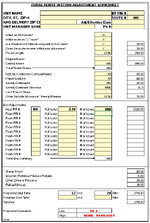
I don't have access to the New Interim Worksheet, but it works the same way, just more data placements. (Like Load Time, Stop Signs, Ect.. Cells) This worksheet is Pre RRECS but still works in the same manor.

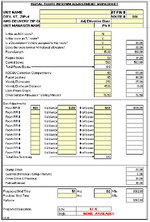
First here is the worksheet of say RT. 1 and it came out at a 48k. Time to cut it down to a 43k.
Inter1.jpg

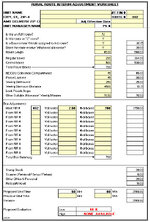
If you notice if I change one little thing the whole route eval changes. So I change the use of Gov Vehicle.
Inter2.jpg
It takes away that value and it now drops to a 47K. These numbers have to be correct or you will end up with a wrong calculation of the route. (Only the yellow boxes can be changed, the white show cells show the calculation.) (Remember there is even more cells Like Load Time, Stop Signs, Ect.. with the new one)

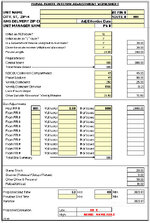
After all that is inputted you can now see how many boxes you need to take away to take it down to a 43k.
After subtracting the numbers of central boxes, I need to take away 83 central boxes. (CBU)
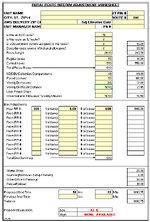
Inter3.jpg

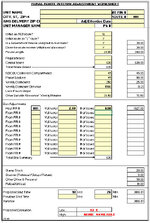
I now need to go to the route and find a neighborhood that has close to 83 boxes to take away. Just to start. I find a neighborhood that has 70 boxes. Great, maybe it will work.
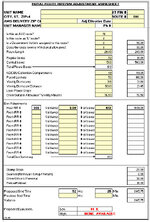
Inter4.jpg

Oh, it came back as a 44k. Well that won't work!
But wait, I need to adjust mileage, parcel lockers, dismount distance, ect.
Inter5.jpg
 
Oh lucky me, it worked out because after looking over the map the RT lost 5 miles. Came out as a 43k.
Even adjusting the parcel lockers, dismounts, ect.. it still is a 43k.
Inter6.jpg
Now the cutting of that rt is complete. And I now have to figure out where to put the cut area to.
Now let's say there is RT#2. It has a different Vol Factor at 2.50. More Regular Boxes, but less Cent Boxes then RT#1. But it is still over at 48k.

Inter7.jpg
Now we have to figure out how many boxes to take away.
I would need to take away 125 Cent Boxes just to get it to a 43k. The Volume Factor really changed how many boxes are need to take away.
Inter8.jpg
So you can see how just the Volume Factor alone changes the need to take away more boxes.
I hope this helps trying to understand why there is such a difference between two routes.
 
There is only 10 mins different between them. I don't have that info, but the one getting more boxes taken off was 10 mins more than the other. I believe both were just over the standard hours for a 48K. The one route was 46K and gained 2 more hours.
Precise starting and ending STANDARD HOURS would have been helpful to discern i would think . But who knows !
 
To even simplify more. Say you have the same route everything is the same, just volume factor is different.
Just a .10 volume factor difference is 63:49 compared to 62:29. Crazy huh????

Interm1.jpg
Interm3.jpg

Only difference is Vol Factor. One at 3.00 the other at 2.90 as above.
There would be a 5 box difference and the time changes a lot.
A difference of 52:09 with the 3.00 Vol Factor
VS
A difference of 51:26 with the 2:90 Vol Factor

A 33 Min difference!!!
Interm2.jpg
Interm4.jpg
 

Attachments

  • Interm3.jpg
    Interm3.jpg
    98 KB · Views: 1
Also even though there is a 10 min difference with your two routes. Everything is taken into effect. Measurements in office and authorized dismounts distances play a factor in adjusting also. But as you change things around, the calculations change differently also.
 
I'm talking from experience running both of these routes. Based on that along it isn't even close time wise to do.

I'll bet money a year from now when these dumb cuts go into place.

The one that got less boxes take off with be closer to 45k which is their goal.

The other one will be 41k or maybe 42k.

I'm going on my experience doing these routes and what they are taking off isn't even close to same.

I sure hope union looks into this personally.
It doesn't matter. It is based upon each routes average volume numbers. Not specific addresses or streets.
It's not unusual for such a circumstance to happen based upon an adjustments numbers.

The total, combined volumes on each route may indicate higher box loss on second route.

It's a formula issue. As the rt volume is aggregate per route, not area of rt, it may be the 81 box loss has horrible volume on the rest of the route.
 
Back
Top