2024-2027 NRLCA-USPS Tentative National Agreement Has Been Ratified

Maybe I’m in the minority here but I’m willing to have smaller but more consistent gains along with stable employment than getting a UPS style deal and then letting go of 20k people.
The mechanics of UPS employment stability aren't the same mechanics within our system.

I don't know the workload-per-employee ratio for UPS, but if they had the ability to sever that number of employees, did they reasonably have that much work for them to perform? Additionally, what part of the work force was severed; part-time, temporary, full-time?

It's not clear to me what you mean by "stable employment", but recall that non-career employees can be severed in the leave replacement ranks. (See Article 30.2.I.)

Additionally, it's not clear to me whether you associate "stable employment" with "stable wage". If the employment isn't desirable, and the wage doesn't compensate for that lack of desire, it may result in a lack of applicants or hires that exceed their probationary period.

I’m more of a big picture type of person as much as being on table 2 rightfully pisses me off.
Consider organizing fellow table 2 carriers to rise a table 2 carrier (or more) to the national board.

Because I could say “why didn’t you folks back then in 2012 just vote to pass the bleepin thing?? Instead of letting a betrayer determine our destiny? Because now we have this?”
It's easy to fall victim to Monday morning quarterbacking. If I recall correctly, the board took that decision upon themselves.

Watch what a NO vote can cause… think about that.
🏴‍☠️
It's also easy to fall victim to a slippery slope.

Should the option of arbitration be stricken from the contract? Should the delegates amend the union's constitution to grant only the National Board the right to adopt or reject National Agreements?

While this solution would halt the membership's consideration of anything other what the National Board wanted, it would also justify the 2012 result you've raised in rebuttal.
 
The mechanics of UPS employment stability aren't the same mechanics within our system.

I don't know the workload-per-employee ratio for UPS, but if they had the ability to sever that number of employees, did they reasonably have that much work for them to perform? Additionally, what part of the work force was severed; part-time, temporary, full-time?

It's not clear to me what you mean by "stable employment", but recall that non-career employees can be severed in the leave replacement ranks. (See Article 30.2.I.)

Additionally, it's not clear to me whether you associate "stable employment" with "stable wage". If the employment isn't desirable, and the wage doesn't compensate for that lack of desire, it may result in a lack of applicants or hires that exceed their probationary period.


Consider organizing fellow table 2 carriers to rise a table 2 carrier (or more) to the national board.


It's easy to fall victim to Monday morning quarterbacking. If I recall correctly, the board took that decision upon themselves.


It's also easy to fall victim to a slippery slope.

Should the option of arbitration be stricken from the contract? Should the delegates amend the union's constitution to grant only the National Board the right to adopt or reject National Agreements?

While this solution would halt the membership's consideration of anything other what the National Board wanted, it would also justify the 2012 result you've raised in rebuttal.
I don’t disagree with anything you’ve said. I was saying that I could be slamming folks from 2012. It’s true that no one predicted they would come up with those plans and therefore make second class carriers. I’m not saying to take arbitration off of the table either in fear of what might be. Never the less my point is clear that voting no can have very damaging effects. Of course that doesn’t mean I’m stating to never vote no either.
I appreciate your reply.
 
I felt like NRLCA was still sore about the previous contract getting voted down, and weren't looking for a repeat.... so they didn't agree to anything and it went straight to an arbitrator with no vote.... I feel like they did a very poor job of arguing at arbitration, and lost our @$$ there... it was a horrible contract.... and every since then NRLCA always says vote yes or you'll lose your @$$ at arbitration, and 2012 is an example of that.... :unsure: 🤷‍♂️👉:oops:
Wow if that’s the case then they royally boned themselves by screwing the new blood coming in and expecting them to still respect a union who would deliberately sell their livelihood down the river for spite sake… ugh I hope you’re wrong but it is what it is in the end.
 
I don’t disagree with anything you’ve said. I was saying that I could be slamming folks from 2012. It’s true that no one predicted they would come up with those plans and therefore make second class carriers. I’m not saying to take arbitration off of the table either in fear of what might be. Never the less my point is clear that voting no can have very damaging effects. Of course that doesn’t mean I’m stating to never vote no either.
I appreciate your reply.
If the union's negotiators released to the membership all of the bargaining notes along with the tentative agreements, perhaps its members would cast more informed "yea" and "nay" votes. 🤔

I suspect they'd go with the "we can't risk letting management see these notes or we're doomed!" boogeyman routine if it were pressed. :rolleyes:

This solution, however, requires members to actually read what they're voting on. Who knows how many actually would do so. 🤷‍♂️
 
If the union's negotiators released to the membership all of the bargaining notes along with the tentative agreements, perhaps its members would cast more informed "yea" and "nay" votes. 🤔

I suspect they'd go with the "we can't risk letting management see these notes or we're doomed!" boogeyman routine if it were pressed. :rolleyes:

This solution, however, requires members to actually read what they're voting on. Who knows how many actually would do so. 🤷‍♂️
Intent, level of desire, what was turned down at the very least! They have to tell USPS the terms they want anyways, what would exposing the fails be giving up? I'd accept a partial list, headlines only even. Just speak to us! This is supposed to be influenced by the people working through these conditions after all.
 
Well thank you for making that clear because I honestly didn’t know.
That was an odd circumstance in 2012... in 2006 the previous contract got voted down and went to arbitration, so after that was up in 2010 they negotiated for a while, but never came to an agreement, so they went straight to arbitration without a vote by the members... they like to blame the contract on the arbitrator, but I blame them for not doing a better job at arguing at arbitration.... it was a real stinker regardless... :unsure: 🤷‍♂️👉🧐
 
Wow if that’s the case then they royally boned themselves by screwing the new blood coming in and expecting them to still respect a union who would deliberately sell their livelihood down the river for spite sake… ugh I hope you’re wrong but it is what it is in the end.
I really don't know for sure what all their motivations were... maybe USPS was proposing so much negative stuff that they simply couldn't accept it, or if there was more to it... I really never heard anything other than the talks came to an impasse and they were going to arbitration.... :unsure: 🤷‍♂️👉🧐
 
I really don't know for sure what all their motivations were... maybe USPS was proposing so much negative stuff that they simply couldn't accept it, or if there was more to it... I really never heard anything other than the talks came to an impasse and they were going to arbitration.... :unsure: 🤷‍♂️👉🧐
This has been discussed & explained numerous times at the conventions.

APWU came up with the 2-Tier & our Union disagreed as did the other Unions.
Our Union was also fighting to get an update on mail count items for more credits. Quite a few credits we had in the old Count system were agreed to & not timed for an average credit. The PO wasn’t giving us more credit for anything & felt that we were already overpaid.
There were other things but those were the biggest & our Board would not even entertain any of it.
All of us Unions have had to fight hard to overcome that Contract period.
 
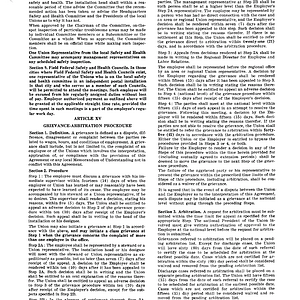
Here, take the time to read about it.
This is the convention proceeding magazine.
Pg 533 under negotiations.
I can't just copy and paste here for some reason


Our craft was under attack and our board responded in what they thought was the best way.
There are more parts to this that gives the climate of the time.
PMG Donahoe address on page 490. It's quite interesting to know what we know now and peek back to the beginning of the chaos.
 
This has been discussed & explained numerous times at the conventions.

APWU came up with the 2-Tier & our Union disagreed as did the other Unions.
Our Union was also fighting to get an update on mail count items for more credits. Quite a few credits we had in the old Count system were agreed to & not timed for an average credit. The PO wasn’t giving us more credit for anything & felt that we were already overpaid.
There were other things but those were the biggest & our Board would not even entertain any of it.
All of us Unions have had to fight hard to overcome that Contract period.
They certainly didn't convince the arbitrator of anything in that arbitration then tho, apparently, as all the time standard changes were for the worse, as was about everything in that contract... hard to say who's fault it was, but it really was a bloodbath... :unsure: 🤷‍♂️👉🤯
 
November 2011 (proceeding issues)
I suppose it's likely the issue won't automatically pull up for you all.

Nrlca.org
Password
Member resources
Click on the magazine option
Scroll to Archives

🙄 sorry it's not easier
 
This has been discussed & explained numerous times at the conventions.

APWU came up with the 2-Tier & our Union disagreed as did the other Unions.
Our Union was also fighting to get an update on mail count items for more credits. Quite a few credits we had in the old Count system were agreed to & not timed for an average credit. The PO wasn’t giving us more credit for anything & felt that we were already overpaid.
There were other things but those were the biggest & our Board would not even entertain any of it.
All of us Unions have had to fight hard to overcome that Contract period.
Also, everybody likes to blame APWU for 2 tier pay, but they really didn't invent it.... other unions like UAW, and others were getting it at the time as companies were asking for givebacks, supposedly temporary, to help with rough economic times, so of course USPS jumped on that bandwagon... many of those other unions have since shed the 2-tier pay, but not the good ole USPS... imo, that's more failures of the postal unions...
 
DB et al -- "I really don't know for sure what all their motivations were... maybe USPS was proposing so much negative stuff that they simply couldn't accept it, or if there was more to it... I really never heard anything other than the talks came to an impasse and they were going to arbitration..."

-- Seems like it was the NRLCA who was proposing the negative stuff for the rural carriers:

-- From Clarke's "award":

- The NRLCA first proposed and the USPS late agreed to re-do the evaluated compensation system based on sound engineering principles.

- ...the NRLCA's proposal of alternating three and two week [ instead of 4- and 2-week counts in September ] mail counts during the February/March timeframe should be adopted.

- One year the NRLCA went with "no contract, no mail count". That probably resulted in the middle of March 2016 mail count when there wasn't a contract.

-- Apparently the NRLCA negotiating team didn't sufficiently impress Clarke, which led to rural carriers needing 10 years as a regular before opting for the High Option. AUX routes needed 42 hours instead of 39 to be converted to a regular route.

-- Then-President Dwyer opted for the NRLCA and the USPS to cobble together a new compensation system instead of letting Clarke propose one.

-- In the RRECS Q&A, Dwyer said she never considered not being under the evaluation system. Apparently not willing to let rural carriers decide on hourly or evaluated compensation.
 
DB et al -- "I really don't know for sure what all their motivations were... maybe USPS was proposing so much negative stuff that they simply couldn't accept it, or if there was more to it... I really never heard anything other than the talks came to an impasse and they were going to arbitration..."

-- Seems like it was the NRLCA who was proposing the negative stuff for the rural carriers:

-- From Clarke's "award":

- The NRLCA first proposed and the USPS late agreed to re-do the evaluated compensation system based on sound engineering principles.

- ...the NRLCA's proposal of alternating three and two week [ instead of 4- and 2-week counts in September ] mail counts during the February/March timeframe should be adopted.

- One year the NRLCA went with "no contract, no mail count". That probably resulted in the middle of March 2016 mail count when there wasn't a contract.

-- Apparently the NRLCA negotiating team didn't sufficiently impress Clarke, which led to rural carriers needing 10 years as a regular before opting for the High Option. AUX routes needed 42 hours instead of 39 to be converted to a regular route.

-- Then-President Dwyer opted for the NRLCA and the USPS to cobble together a new compensation system instead of letting Clarke propose one.

-- In the RRECS Q&A, Dwyer said she never considered not being under the evaluation system. Apparently not willing to let rural carriers decide on hourly or evaluated compensation.
We took some time standard hits as well.... I seem to recall they drastically cut time for DPS pieces... and some other things as well... I really don't recall anything good about that contract... :unsure: 🤷‍♂️👉🤯
 
We took some time standard hits as well.... I seem to recall they drastically cut time for DPS pieces... and some other things as well... I really don't recall anything good about that contract... :unsure: 🤷‍♂️👉🤯
Yes, we did . From The Clarke "Award" ;

A. Delivery Point Sequence (DPS) Letter Mail – 43 pieces per minute for
routes with an assigned Employer provided vehicle.

B. Prepaid Parcels Accepted – 90 seconds per event and 9 seconds per
parcel. Prepaid parcels accepted will be removed from its current category
for credit during the mail count, Parcels Accepted, Ordinary, Insured,
C.O.D.; and be credited in the same category as Carrier Pickup ‘Request’
and Carrier Pickup ‘Items’, as appropriate.

C. Credit for walking speed – 0.00429 minutes per foot.

5. Amend Article 9.2.C.7.a(3) to provide:

A regular carrier must have a minimum of ten (10) years from his or her
retirement computation date to be eligible to elect the high option.

6. Amend Article 12.3.A.3 to provide:

The threshold for converting auxiliary rural routes to regular routes will be
changed from thirty-nine (39:00) weekly standard hours to forty-two
(42:00) weekly standard hours. These routes will be converted within thirty
(30) days of the increase to 42:00 standard hours, unless the increase is
as a result of a mail count. In the latter circumstance, the conversion will
be effective with the mail count


The DPS standard w/Govt. vehicle WAS 30 ppm and went to 43 ppm. 40 hours WAS the threshold for a route to be a regular route and went to 42 hours. With the standard(s) beatings, it becomes even more difficult to achieve regular route status. The "ten year" thing is just unconscionable.. With the generally accepted " 20 years working anywhere is a career" , that is HALF of a career being denied the high option income which also affects OTHER income AFTER retirement when one considers TSP, Social Security, etc.
 
Yes, we did . From The Clarke "Award" ;

A. Delivery Point Sequence (DPS) Letter Mail – 43 pieces per minute for
routes with an assigned Employer provided vehicle.

B. Prepaid Parcels Accepted – 90 seconds per event and 9 seconds per
parcel. Prepaid parcels accepted will be removed from its current category
for credit during the mail count, Parcels Accepted, Ordinary, Insured,
C.O.D.; and be credited in the same category as Carrier Pickup ‘Request’
and Carrier Pickup ‘Items’, as appropriate.

C. Credit for walking speed – 0.00429 minutes per foot.

5. Amend Article 9.2.C.7.a(3) to provide:

A regular carrier must have a minimum of ten (10) years from his or her
retirement computation date to be eligible to elect the high option.

6. Amend Article 12.3.A.3 to provide:

The threshold for converting auxiliary rural routes to regular routes will be
changed from thirty-nine (39:00) weekly standard hours to forty-two
(42:00) weekly standard hours. These routes will be converted within thirty
(30) days of the increase to 42:00 standard hours, unless the increase is
as a result of a mail count. In the latter circumstance, the conversion will
be effective with the mail count


The DPS standard w/Govt. vehicle WAS 30 ppm and went to 43 ppm. 40 hours WAS the threshold for a route to be a regular route and went to 42 hours. With the standard(s) beatings, it becomes even more difficult to achieve regular route status. The "ten year" thing is just unconscionable.. With the generally accepted " 20 years working anywhere is a career" , that is HALF of a career being denied the high option income which also affects OTHER income AFTER retirement when one considers TSP, Social Security, etc.
Well I guess what the union reps do in Vegas does not stay in Vegas It goes to management to be used to put it to the rest of us.
 
Yes, we did . From The Clarke "Award" ;

A. Delivery Point Sequence (DPS) Letter Mail – 43 pieces per minute for
routes with an assigned Employer provided vehicle.

B. Prepaid Parcels Accepted – 90 seconds per event and 9 seconds per
parcel. Prepaid parcels accepted will be removed from its current category
for credit during the mail count, Parcels Accepted, Ordinary, Insured,
C.O.D.; and be credited in the same category as Carrier Pickup ‘Request’
and Carrier Pickup ‘Items’, as appropriate.

C. Credit for walking speed – 0.00429 minutes per foot.

5. Amend Article 9.2.C.7.a(3) to provide:

A regular carrier must have a minimum of ten (10) years from his or her
retirement computation date to be eligible to elect the high option.

6. Amend Article 12.3.A.3 to provide:

The threshold for converting auxiliary rural routes to regular routes will be
changed from thirty-nine (39:00) weekly standard hours to forty-two
(42:00) weekly standard hours. These routes will be converted within thirty
(30) days of the increase to 42:00 standard hours, unless the increase is
as a result of a mail count. In the latter circumstance, the conversion will
be effective with the mail count


The DPS standard w/Govt. vehicle WAS 30 ppm and went to 43 ppm. 40 hours WAS the threshold for a route to be a regular route and went to 42 hours. With the standard(s) beatings, it becomes even more difficult to achieve regular route status. The "ten year" thing is just unconscionable.. With the generally accepted " 20 years working anywhere is a career" , that is HALF of a career being denied the high option income which also affects OTHER income AFTER retirement when one considers TSP, Social Security, etc.
They pursued those new standards non-stop... they were mandating everybody count every chance they got.... those were not good days to be a rural carrier... :unsure: 🤷‍♂️👉(n)
 
Back
Top